L-Shaped Outdoor Kitchen: Layout Ideas, Dimensions & Design Guide
L-shaped outdoor kitchen layouts cut walking distance 30 to 40 percent versus straight runs. Compare leg lengths, corner solutions,
By Sukie
Editor · compiles manufacturer specs and building-code references into the measurement guides on this site
The L-shaped outdoor kitchen is the most versatile and efficient layout for backyard cooking spaces, striking an ideal balance between generous counter area, natural workflow optimization, and a social design that keeps the cook connected to guests without feeling cramped or isolated. Formed by two perpendicular counter runs that meet at a 90-degree corner, the L-shape creates a natural work triangle between the grill, sink, and prep area that reduces walking distance by 30 to 40 percent compared to a straight-line kitchen while avoiding the enclosed, boxed-in feeling of a U-shaped layout. The L-shaped configuration works on patios as small as 10 by 10 feet and scales gracefully to 20-foot runs or larger for premium builds with multiple cooking stations. According to kitchen design data from the National Kitchen and Bath Association, the L-shape is the second most popular outdoor kitchen layout after the straight line, chosen by approximately 28 percent of homeowners building new outdoor kitchens, and it consistently receives the highest satisfaction ratings for both functionality and entertaining because it naturally separates the hot cooking zone from the social seating zone along the perpendicular wing. Costs for an L-shaped outdoor kitchen range from $6,000 for a basic DIY build with a single grill, CMU block base, and concrete countertops to $35,000 or more for a fully loaded setup with premium appliances from brands like Lynx, Hestan, or Kalamazoo, granite countertops, natural stone veneer, and integrated seating along the bar wing. This guide covers every aspect of planning, dimensioning, and building an L-shaped outdoor kitchen, from choosing the optimal leg lengths and appliance arrangement to solving the notoriously tricky corner problem and deciding whether the L-shape is actually the right layout for your specific property and cooking style.
Top Picks: Best L-Shaped Outdoor Kitchen: Layout Ideas, Dimensions & Design Guide in 2026
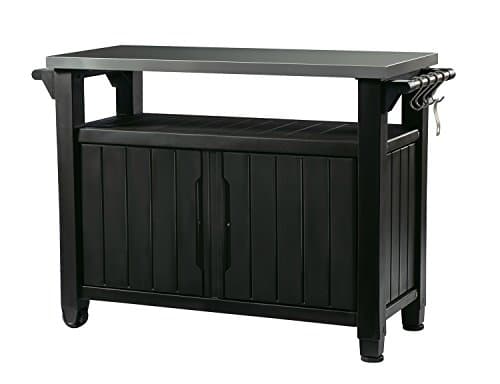
Keter Unity XL Portable Outdoor Table with Stainless Steel Top for Kitchen Prep and Outdoor Storage Cabinet for Grilling Accessories, Dark Grey
$220.99
Shop Now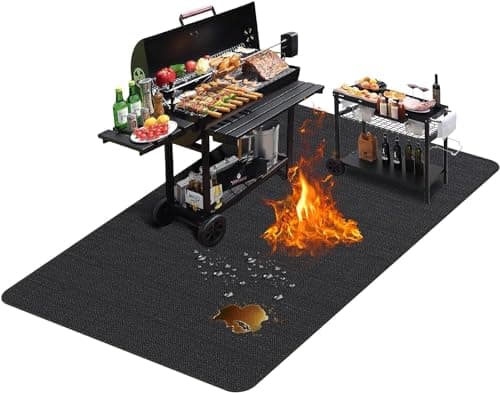
TAOMAND Large 76 x 52 inches Under Grill Mats for Outdoor Grill | Double-Sided Fireproof | Waterproof | Oil-Proof | Easy to Clean | Indoor Fireplace/Fire Pit Mat | Quality BBQ Mat for Deck Patio Lawn
$33.99
Shop Now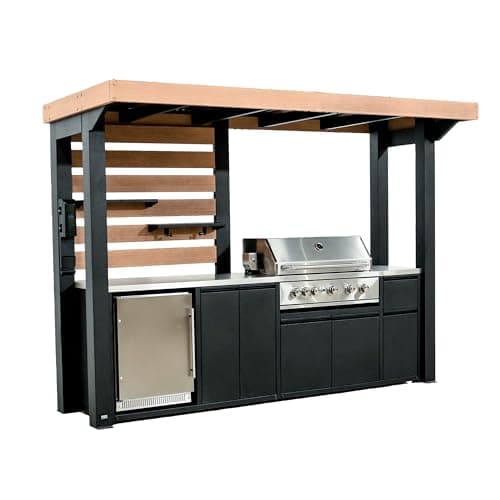
Backyard Discovery Fusion Flame Galvanized Steel Covered Outdoor Kitchen with 5-Burner Stainless, Grill, Refrigerator, Countertop, Storage, and, Roof for All-Season Outdoor Cooking, electric
$4,999.00
Shop Now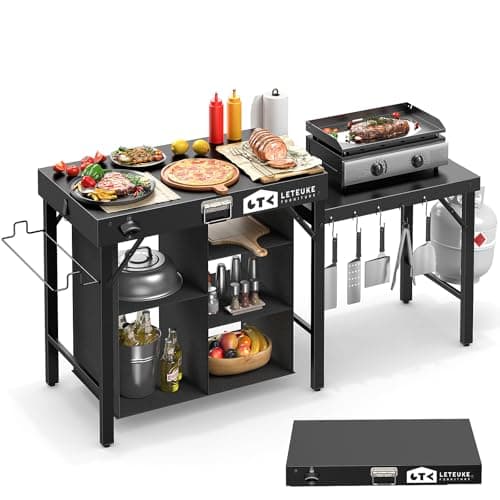
Leteuke Grill Table for Blackstone Griddle, Portable Foldable Grill Table with Storage Fits Ninja, Blackstone Griddle Stand for Outdoor Camping, Picnic, Garden, Patio, Dining, BBQ, Party
$159.99
Shop Now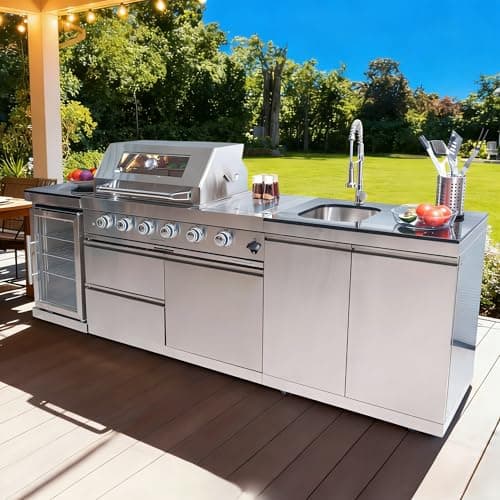
98 Inches Outdoor Kitchen Island, 4-Burner 72000 BTU Propane Stainless Steel BBQ with Side/Rear Burners, With Refrigerator and Sink, Rotisserie, Granite Countertops, Storage, For Backyard BBQ, Silver
$3,652.00
Shop Now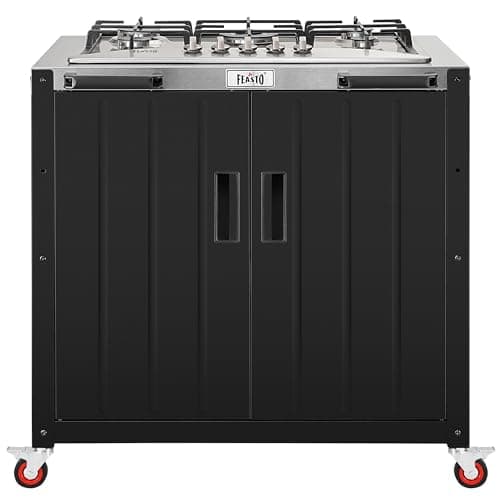
Feasto Gas Grill, Movable Outdoor Gas Stove Stainless Steel Top with Cabinet, 5 Burners with 36,200 BTUs, Outdoor Propane Grill for Outdoor Cooking, Ideal for Lawn & Garden, L35.4 x W24
$539.99
Shop NowKeter Unity XL Portable Outdoor Table with Stainless Steel Top for Kitchen Prep and Outdoor Storage Cabinet for Grilling Accessories, Dark Grey
$220.99
Shop NowTAOMAND Large 76 x 52 inches Under Grill Mats for Outdoor Grill | Double-Sided Fireproof | Waterproof | Oil-Proof | Easy to Clean | Indoor Fireplace/Fire Pit Mat | Quality BBQ Mat for Deck Patio Lawn
$33.99
Shop NowBackyard Discovery Fusion Flame Galvanized Steel Covered Outdoor Kitchen with 5-Burner Stainless, Grill, Refrigerator, Countertop, Storage, and, Roof for All-Season Outdoor Cooking, electric
$4,999.00
Shop NowLeteuke Grill Table for Blackstone Griddle, Portable Foldable Grill Table with Storage Fits Ninja, Blackstone Griddle Stand for Outdoor Camping, Picnic, Garden, Patio, Dining, BBQ, Party
$159.99
Shop Now98 Inches Outdoor Kitchen Island, 4-Burner 72000 BTU Propane Stainless Steel BBQ with Side/Rear Burners, With Refrigerator and Sink, Rotisserie, Granite Countertops, Storage, For Backyard BBQ, Silver
$3,652.00
Shop NowFeasto Gas Grill, Movable Outdoor Gas Stove Stainless Steel Top with Cabinet, 5 Burners with 36,200 BTUs, Outdoor Propane Grill for Outdoor Cooking, Ideal for Lawn & Garden, L35.4 x W24
$539.99
Shop NowWhy Choose an L-Shaped Outdoor Kitchen Layout Over Other Configurations
The L-shaped outdoor kitchen layout solves specific problems that other configurations either create or cannot address. Compared to a straight-line kitchen, which forces you to walk back and forth along a single axis like a short-order cook working a diner counter, the L-shape puts your three most-used stations, the grill, the sink, and the main prep area, within a tight triangle that keeps total walking distance between any two points under 6 feet. This work triangle concept, borrowed from indoor kitchen design where it has been the gold standard since the 1940s, means you can turn from grilling to rinsing vegetables to chopping garnishes with a simple pivot rather than a 10-foot trek. For the typical backyard cook who spends 20 to 40 minutes actively moving between stations during meal prep, this layout saves hundreds of steps per cooking session and significantly reduces fatigue during long BBQ events.
Compared to a U-shaped kitchen, the L-shape is 30 to 50 percent less expensive because it requires one fewer counter run, fewer structural supports, and shorter utility runs. It also avoids the enclosed tunnel feel that many homeowners dislike about U-shaped layouts, where guests and family members cannot easily approach the cook or participate in the cooking process. The open side of the L creates a natural gathering point where people can stand, lean, or pull up bar stools without being in the cook's way. Compared to an island layout, the L-shape keeps all utilities on connected walls rather than requiring expensive trenching across the patio to reach a freestanding island, saving $1,500 to $4,000 in utility routing alone. The L-shape also anchors naturally into a corner of your patio or against two perpendicular property boundaries, making efficient use of space that would otherwise be dead corner area. The primary scenario where an L-shape is not the best choice is when you have a very narrow patio under 8 feet wide, which cannot accommodate the perpendicular wing, or when you specifically want the 360-degree access of a freestanding island for social cooking. For a full overview of every component, layout option, and design path, see our complete outdoor kitchen setup guide.
Optimal Dimensions and Proportions for an L-Shaped Outdoor Kitchen
Getting the dimensions right determines whether your L-shaped outdoor kitchen feels spacious and efficient or cramped and awkward. The long leg, where the primary grill and most counter space are positioned, should measure 8 to 14 feet depending on the number of appliances and the amount of prep space you want. A 10-foot long leg comfortably accommodates a 36-inch built-in grill, 24 inches of counter space on each side of the grill, and a 15-inch prep sink at the far end. A 12-foot long leg opens up room for a secondary appliance like a side burner or flat-top griddle. The short leg, which typically houses the bar seating area or secondary work zone, should be 4 to 8 feet long. A 6-foot short leg provides enough room for three bar stools with 24 inches of space per seat, which is the recommended minimum per stool.
Counter depth for both legs should be 25 to 27 inches for the work surface side, which accommodates standard 24-inch-deep base cabinets plus a 1.5-inch countertop overhang. If the short leg serves as a bar with seating on the outside, increase the countertop depth to 30 to 36 inches to create a 12 to 15-inch overhang on the guest side for knee clearance, while maintaining the full work surface depth on the inside. Counter height follows the same standards as any outdoor kitchen: 36 inches for the working side and 42 inches for a raised bar section. When designing a two-tier counter on the short leg, the 36-inch lower level faces the cook and the 42-inch upper level faces the guests, with a 6-inch step creating the visual separation that hides prep mess from the dining side. Overall, the interior open space inside the L should be at least 42 inches from the front edge of the long leg to the nearest obstruction, and 48 inches is preferred for comfortable two-person movement. If your patio cannot provide 48 inches of clear space inside the L after accounting for counter depth, consider a more compact configuration or a straight-line layout instead.
Does an L-shaped outdoor kitchen add home value
Yes, an L-shaped outdoor kitchen adds significant home value. According to the National Association of Realtors, outdoor kitchens return 55 to 75 percent of their construction cost at resale, with well-designed L-shaped and U-shaped layouts at the higher end of that range. In warm-climate states like Florida, Texas, California, and Arizona, the return can exceed 100 percent because outdoor living space is a top buyer priority. Quality appliances, granite countertops, and professional finishes maximize resale value.
Work Triangle Optimization in an L-Shaped Outdoor Kitchen
The work triangle is the invisible line connecting your three primary workstations, the grill, the sink, and the main prep surface, and optimizing it is the key to an L-shaped kitchen that feels effortless to cook in. The National Kitchen and Bath Association recommends that the sum of all three triangle sides should fall between 12 and 26 feet, with no single side shorter than 4 feet or longer than 9 feet. In an L-shaped outdoor kitchen, the most efficient arrangement places the grill on the long leg near the corner, the sink at the end of the long leg, and the primary prep surface on the short leg. This creates a compact triangle with sides of approximately 4 to 5 feet each, totaling 12 to 15 feet, which is at the efficient end of the recommended range.
An alternative arrangement that works well for kitchens with a bar-seating short leg places the grill centered on the long leg, the sink in the corner where the legs meet, and prep space on both sides of the grill. This approach keeps the wettest workstation, the sink, at the corner where plumbing connections are most straightforward and puts the grill at the focal point of the long leg where it has maximum counter landing space on both sides. Avoid placing the grill at the far end of the long leg away from the corner, because this isolates the cook from the social area and stretches the work triangle beyond comfortable distances. Similarly, avoid placing the sink at the far end of the short leg, because you will find yourself walking the full length of both legs every time you need to rinse something during cooking. Think of the corner as the hub of your L-shaped kitchen and position the two most-used stations, typically the grill and the sink, within 5 feet of that hub on either side. The prep surface naturally falls on the remaining counter space. Test your planned layout by walking through a typical meal preparation sequence: get meat from fridge, carry to prep surface, season, carry to grill, return to prep surface, chop vegetables, rinse in sink, plate and serve. Every step should feel natural and short.
Solving the Corner Problem in L-Shaped Outdoor Kitchen Design
The inside corner where the two legs of an L-shaped outdoor kitchen meet is simultaneously the most important and most challenging part of the design. Done right, the corner becomes prime functional real estate. Done wrong, it becomes an awkward dead zone that wastes expensive countertop material and creates an uncomfortable blind spot in your workflow. The most common corner mistake is creating a sharp 90-degree inside corner with full-depth countertops on both sides, which produces a deep triangular area in the back corner that your arms cannot reach comfortably. The standard human reach while standing is approximately 24 inches, but a 90-degree corner with 27-inch-deep counters creates a back corner that is 38 inches from the front edge, putting it 14 inches beyond comfortable reach.
The best solution for L-shaped outdoor kitchen corners is the diagonal or chamfered corner, where you cut a 45-degree flat across the inside corner, typically 18 to 24 inches on each side. This eliminates the unreachable dead zone while creating a natural transition point between the legs. Position the sink at this diagonal section because it becomes the perfect hub location within arm's reach of both legs. A 15-inch prep sink like the Ruvati 15-Inch Outdoor Sink ($289) or Blaze 15-Inch Sink ($349) fits perfectly in a diagonal corner section. Another effective approach is the radius corner, where the inside edge curves in a smooth arc rather than meeting at a sharp angle. This requires custom countertop fabrication, adding $200 to $500 to your granite or concrete countertop cost, but it eliminates pinch points and creates an ergonomic workflow. A third option is to leave the corner open as a pass-through, removing the countertop from the innermost 18 inches of the corner to create a walkway between the inside and outside of the L. This works well when the short leg serves as a bar because it gives the cook a way to step out of the kitchen without walking around the entire structure. For storage, install a lazy Susan or pull-out corner tray system in the base cabinet below the corner to maximize the usefulness of what would otherwise be dead storage space.
L-Shaped Outdoor Kitchen vs Straight Line vs U-Shaped: Complete Comparison
Choosing between an L-shaped, straight-line, and U-shaped outdoor kitchen depends on your available space, budget, cooking style, and entertainment priorities. Here is how they compare across every major factor. For space efficiency, the straight-line layout requires the least total footprint, fitting into as little as 8 linear feet against a single wall, making it ideal for narrow patios, townhouse yards, and balconies. The L-shape needs a minimum corner footprint of 8 by 6 feet and is best suited for patios of 10 by 10 feet or larger. The U-shape demands the most space, requiring a minimum 10-by-10-foot interior work area plus the 27-inch counter depth on three sides, which means a total footprint of at least 14.5 by 14.5 feet. For cost, a basic straight-line kitchen runs $3,000 to $10,000, an L-shape runs $6,000 to $25,000, and a U-shape runs $12,000 to $40,000 at similar quality levels.
For workflow efficiency, the straight line scores lowest because it forces a linear back-and-forth pattern with no natural work triangle. The L-shape scores highest for most home cooks because it creates an efficient triangle without excessive walking. The U-shape provides maximum counter space and storage but can create a bottleneck at the entrance, and the cook can feel isolated from guests behind three walls of countertop. For entertaining, the L-shape is widely considered the best layout because the open side creates a natural social zone where guests can gather without entering the work area, and the short leg's bar seating keeps people engaged and comfortable. The straight line offers the least separation between cooking and socializing, which some extroverted cooks prefer but which can create safety concerns with children near the grill. The U-shape maximizes separation but can isolate the cook. For resale value, all three layouts add property value, but L-shaped and U-shaped kitchens with premium finishes command the highest returns because they signal a serious outdoor living investment to buyers. The bottom line: if you have the space and budget, the L-shaped layout delivers the best overall combination of efficiency, entertainment value, and cost-effectiveness for the majority of homeowners.
Appliance Placement and Configuration for L-Shaped Outdoor Kitchens
Strategic appliance placement transforms an L-shaped outdoor kitchen from a good layout into a great one. The golden rule is to place your primary grill on the long leg, ideally positioned 24 to 36 inches from the inside corner, so you have counter landing space on both sides, between the grill and the corner for quick transfers, and between the grill and the end of the long leg for plating and staging. Never position the grill at the very end of the long leg because it eliminates counter space on one side and isolates the cook. For a standard long leg of 10 to 12 feet, the grill centered or slightly off-center toward the corner leaves 36 inches of counter on the inside and 30 to 48 inches on the outside, an ideal distribution. If you are installing a secondary cooking appliance like a side burner, flat-top griddle, or pizza oven, position it on the same long leg, on the opposite side of the grill from the corner, keeping all heat sources on one leg to simplify vent hood coverage and create a clearly defined hot zone.
The outdoor refrigerator should be positioned on the short leg near the corner junction, which places cold storage equidistant from the grill and the prep area. Standard built-in outdoor refrigerators from brands like Blaze (24-inch at $1,399), True Residential (24-inch at $3,299), or Bull (24-inch at $1,199) require a 24-by-24-inch cutout with 2 inches of rear ventilation clearance. Position the refrigerator so its door opens toward the prep area, not into a wall or another appliance. The sink placement depends on whether you chose the diagonal corner solution or a leg-end position. Corner placement keeps the sink central to the work triangle. End-of-long-leg placement puts the sink farthest from the grill, which some cooks prefer because it keeps the wet zone completely separate from the hot zone. If your short leg serves as a bar, install a small ice maker or beverage cooler on the guest-facing side for self-serve drinks. The Blaze 15-Inch Outdoor Ice Maker ($1,099) or the U-Line 15-Inch Clear Ice Machine ($2,299) fits perfectly in a bar-configured short leg and keeps guests supplied without interrupting the cook's workflow.
Building an L-Shaped Outdoor Kitchen: Framing the Corner Connection
The structural corner connection is the most critical construction detail in an L-shaped outdoor kitchen because it must transfer loads between the two legs while maintaining a perfectly plumb and square junction that keeps countertops level and aligned. Whether you are using steel stud framing or concrete masonry units, the corner requires special attention during construction. For steel stud framing, build each leg as a separate rectangular frame, then connect them at the corner using a doubled stud column. This doubled column consists of two studs screwed together in an L-shape with their flanges perpendicular, creating a rigid post that anchors both legs and resists racking forces. Secure the corner column to the base track on both legs using at minimum four 1/4-inch self-tapping hex-head screws per connection point, and add 45-degree diagonal bracing, a short stud running from the top track of one leg to the bottom track of the other, within 24 inches of the corner on both sides.
For CMU block construction, the corner is built by interlocking the block courses in an alternating pattern. On course one, the long-leg blocks run through the corner and the short-leg blocks butt into them. On course two, the pattern reverses, with short-leg blocks running through and long-leg blocks butting in. This interlocking pattern, identical to how brick corners are built, creates a mechanical bond that prevents the legs from separating. Grout all core cells within 24 inches of the corner and insert vertical rebar through at least two cores on each side of the corner joint. After the corner structure is complete, verify square by measuring the diagonal from the outside corner to a point 3 feet along each leg. Both diagonals should be within 1/4 inch of each other. Check level across the corner by placing a 4-foot level diagonally across the top of the corner structure. Any deviation greater than 1/4 inch at this stage will compound when the countertop is installed, creating visible high or low spots that cannot be fixed without shimming. The countertop fabricator will template the corner angle precisely during the site visit, but your structural corner needs to be within 1 degree of the planned angle, whether that is 90 degrees for a standard L or 135 degrees for a diagonal corner, to ensure the countertop fits without visible gaps or overhangs.
L-Shaped Outdoor Kitchen Design Ideas for Every Budget and Style
The design possibilities for L-shaped outdoor kitchens span every aesthetic from rustic farmhouse to sleek modern minimalism, and every budget from thrifty DIY to no-expense-spared luxury. At the entry level of $6,000 to $10,000, a DIY L-shaped kitchen built with CMU blocks, stucco finish, concrete countertops, and a quality mid-range grill like the Weber Summit S-470 Built-In ($2,499) or the Bull Brahma 38-Inch ($3,399) delivers serious cooking performance with a clean, attractive appearance. Use a two-tone stucco approach with a darker shade on the base and lighter shade on the countertop edge for visual depth without the expense of stone veneer. Add four bar stools along the short leg and basic LED strip lighting under the countertop overhang for under $200 total, and you have a highly functional L-shaped kitchen that looks far more expensive than it cost.
At the mid-range of $12,000 to $20,000, upgrade to granite countertops with a polished or leathered finish, natural stone veneer from Eldorado Stone or Cultured Stone on the base, a premium grill like the Blaze Professional LUX 34-Inch ($3,999), an outdoor refrigerator, a prep sink with hot and cold water, and a built-in trash pull-out. This price range also allows for thoughtful details like a 42-inch raised bar section on the short leg with waterfall-edge granite, undercounter lighting, and USB charging outlets for phones and tablets. At the luxury level of $25,000 to $40,000, an L-shaped kitchen becomes a showcase. Think Kalamazoo Hybrid Fire Grill ($11,045 for the built-in K750HB), honed quartzite countertops, custom copper or zinc range hood, integrated Sonos outdoor speakers, a built-in Lynx Napoli Pizza Oven ($7,399), and a professionally installed pergola or pavilion cover with integrated lighting. The L-shaped layout accommodates all of these luxury elements without requiring the additional cost of a third counter run, making it the smart choice for homeowners who want a premium outdoor kitchen without the $50,000-plus price tag of a fully loaded U-shape. Whatever your budget, focus spending on the grill and countertop first because these are the elements you interact with daily, and save on finishing materials and accessories that can be upgraded later.
The details people ask about most:
What are the ideal dimensions for an L-shaped outdoor kitchen?
The ideal L-shaped outdoor kitchen has a long leg of 10 to 12 feet and a short leg of 6 to 8 feet. Counter depth should be 25 to 27 inches for the work surface, expanding to 30 to 36 inches on a bar seating section for 12 to 15 inches of knee-clearance overhang. Maintain at least 42 to 48 inches of open space inside the L for comfortable movement. Counter height is 36 inches for work surfaces and 42 inches for raised bar sections.
How much does an L-shaped outdoor kitchen cost?
An L-shaped outdoor kitchen costs $6,000 to $10,000 for a basic DIY build with a single grill, concrete countertops, and stucco finish. Mid-range builds with granite countertops, stone veneer, a refrigerator, and sink run $12,000 to $20,000. Premium L-shaped kitchens with luxury appliances, natural stone, and professional installation cost $25,000 to $40,000. The L-shape costs 30 to 50 percent less than an equivalent U-shaped kitchen.
Is an L-shaped outdoor kitchen better than a straight line?
An L-shaped outdoor kitchen is better than a straight line for most homeowners because it creates a more efficient work triangle, reduces walking distance between stations by 30 to 40 percent, provides more total counter space, and naturally separates the cooking zone from the social seating area. A straight line is better only when space is limited to a narrow strip under 8 feet wide or when budget is the primary constraint.
How do I handle the corner in an L-shaped outdoor kitchen?
The best corner solutions are a diagonal chamfer that cuts a 45-degree flat across the inside corner, eliminating the unreachable dead zone, or a radius curve that smoothly transitions between the legs. Position the sink at the diagonal corner section for optimal work triangle efficiency. Alternatively, leave the corner open as a pass-through for easy movement between the inside and outside of the L. Install corner cabinet organizers like lazy Susans to maximize base storage in the corner area.
Where should the grill go in an L-shaped outdoor kitchen?
Position the grill on the long leg, 24 to 36 inches from the inside corner, so you have counter landing space on both sides. Never place the grill at the very end of a leg because this eliminates counter space on one side. This positioning keeps the grill central to the work triangle while providing 24 to 48 inches of counter on each side for staging, plating, and tool placement.
How many people can sit at an L-shaped outdoor kitchen bar?
A standard 6-foot bar section on the short leg comfortably seats three people with 24 inches of space per stool, which is the recommended minimum. An 8-foot bar seats four. If you wrap bar seating around the corner and along part of the long leg, you can seat 5 to 6 people. Use counter stools at 24 to 26 inches seat height for 36-inch counters or bar stools at 28 to 30 inches for 42-inch raised bar sections.
Can I add a covered structure over an L-shaped outdoor kitchen?
Yes, L-shaped outdoor kitchens work well under pergolas, pavilions, and roof extensions. A pergola covering the L-shape typically requires a 14-by-14-foot or 16-by-14-foot footprint to cover both legs plus the interior work area. Position support posts at the outside corners of both leg ends and at the outside corner of the L to avoid obstructing the open interior. Budget $4,000 to $12,000 for a wood pergola or $12,000 to $25,000 for a solid-roof pavilion at this size.
What appliances fit in an L-shaped outdoor kitchen?
A 10-foot long leg and 6-foot short leg accommodates a 36-inch built-in grill, a 24-inch outdoor refrigerator, a 15-inch prep sink, and two to three storage access doors and drawers. Upgrading to a 12-foot long leg adds room for a side burner or flat-top griddle. The short leg typically houses the refrigerator and bar seating. For maximum capacity, a 14-foot long leg with an 8-foot short leg can hold a grill, smoker or pizza oven, sink, refrigerator, ice maker, and extensive storage.
How do I run utilities to both legs of an L-shaped outdoor kitchen?
Run all utilities through the long leg first since it typically shares a wall with the house for the shortest connection distance. Gas lines branch at the corner to reach appliances on either leg using a tee fitting. Water supply and drain lines for a corner-mounted sink only need to reach the corner junction. Electrical conduit runs through the base track of both legs, connecting to a single circuit entry point. This consolidated utility routing is one reason the L-shape is more cost-effective than a U-shape.
The layout clearances on this page are compiled from manufacturer documentation and the planning standards published by the National Kitchen & Bath Association; your local building department has the final word.
This guide is part of Outdoor Kitchen Layouts: Straight, L-Shape, U-Shape, and Galley Compared — the hub covering every design & layout guide on Outdoor Kitchen Setup.
Related Guides
Written and edited by Sukie
Sukie is the editor behind Outdoor Kitchen Setup. They compile manufacturer specification sheets, published building codes, and industry sizing standards into the measurement and planning guides on this site, and check every figure against its original source before it goes live. Where a number varies by brand or by local code, the guides say so rather than presenting a single figure as universal.