Outdoor Kitchen Islands: Prefab vs Custom, Sizing, Materials & Best Picks
Outdoor kitchen island choices effectively divide every backyard build into two camps: weekend assemblers who unbox a prefab kit on Saturday morning, and contract builders waiting six weeks for a mason to finish a fully custom block-and-stone monolith.
Photo: William Adams / Pexels (Pexels License)
Top picks for this build
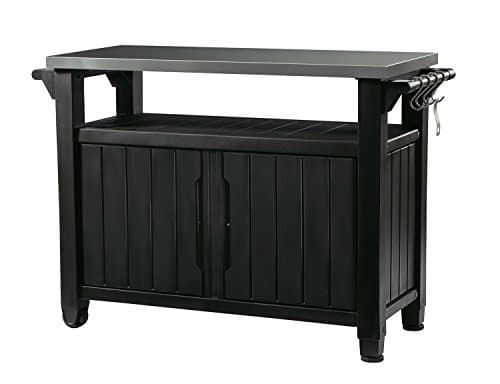
Keter Unity XL Portable Outdoor Table with Stainless Steel Top for Kitchen Prep and Outdoor Storage Cabinet for Grilling Accessories, Dark Grey
$237.99
Check price on Amazon: Keter Unity XL Portable Outdoor Table with Stainless Steel Top for Kitchen Prep and Outdoor Storage Cabinet for Grilling Accessories, Dark Grey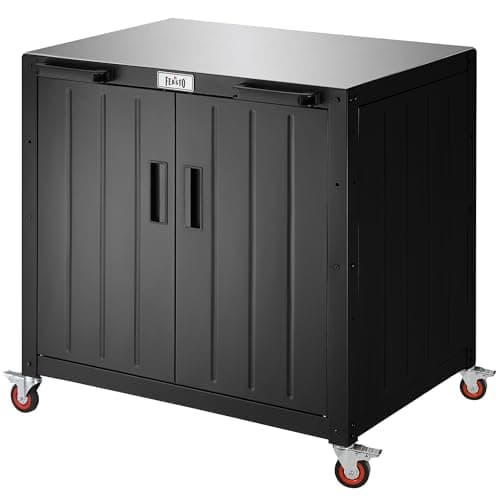
Feasto Outdoor Grill Cart with Storage Cabinet and Stainless Steel Top, 35-Inch Outdoor Grill Station with Door, Modular Kitchen Island for Food Prep and BBQ, Black & Silver
$229.00
Check price on Amazon: Feasto Outdoor Grill Cart with Storage Cabinet and Stainless Steel Top, 35-Inch Outdoor Grill Station with Door, Modular Kitchen Island for Food Prep and BBQ, Black & Silver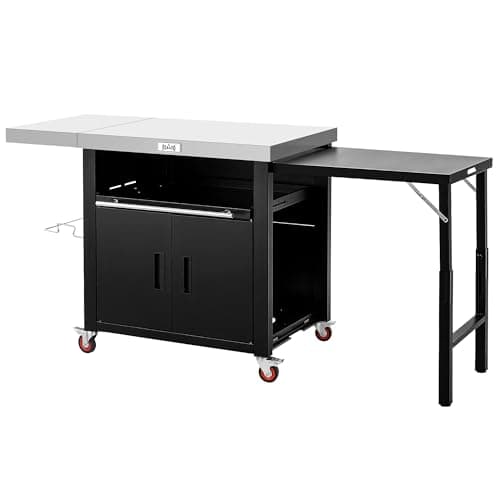
Feasto Outdoor Kitchen Island with Cabinet, Outdoor Grill Table with Stainless Steel Top for Pizza Oven& Griddles, Movable Bar Cart with Pull-Out Plate for Parties& Gathering, Heavy-Duty, L74”x W24”
$259.99
Check price on Amazon: Feasto Outdoor Kitchen Island with Cabinet, Outdoor Grill Table with Stainless Steel Top for Pizza Oven& Griddles, Movable Bar Cart with Pull-Out Plate for Parties& Gathering, Heavy-Duty, L74”x W24”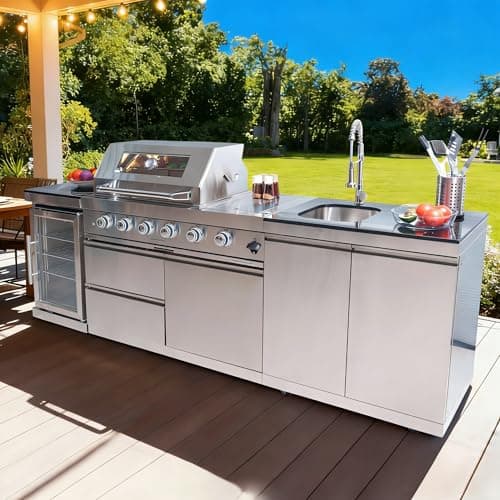
98 Inches Outdoor Kitchen Island, 4-Burner 72000 BTU Propane Stainless Steel BBQ with Side/Rear Burners, With Refrigerator and Sink, Rotisserie, Granite Countertops, Storage, For Backyard BBQ, Silver
$3,652.00
Check price on Amazon: 98 Inches Outdoor Kitchen Island, 4-Burner 72000 BTU Propane Stainless Steel BBQ with Side/Rear Burners, With Refrigerator and Sink, Rotisserie, Granite Countertops, Storage, For Backyard BBQ, Silver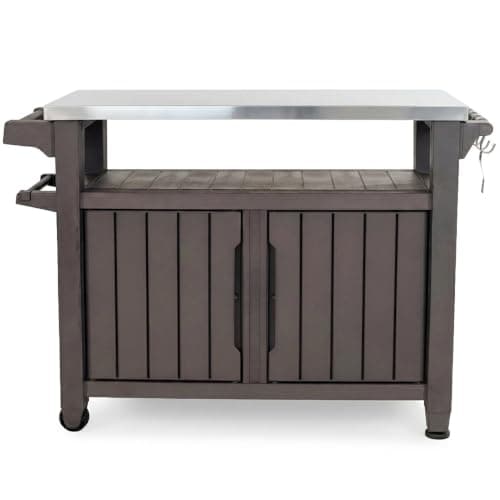
Keter Outdoor Rolling Table Cart for Food Prep, Storage, Bar & Grill, Dark Brown - Portable Kitchen Island Tabletop with Wheels for Drinks, Snacks, and Cooking
See price on Amazon
Check price on Amazon: Keter Outdoor Rolling Table Cart for Food Prep, Storage, Bar & Grill, Dark Brown - Portable Kitchen Island Tabletop with Wheels for Drinks, Snacks, and Cooking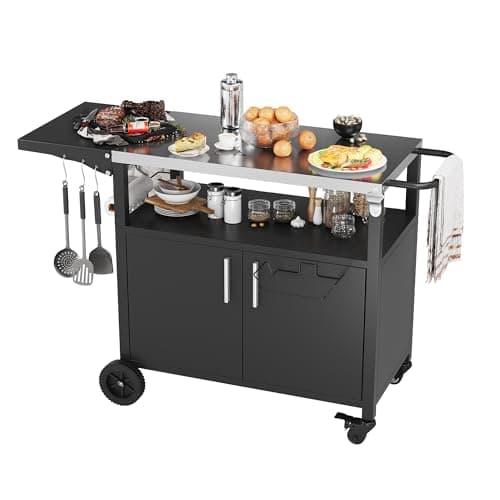
JY QAQA Outdoor Grill Cart with Storage,Patio Kitchen Island Outdoor Grill Table with Wheels,BBQ Cart Movable Pizza Oven Table Stand, Storage Cabinet, Foldable Tabletop, (Black)
$135.98
Check price on Amazon: JY QAQA Outdoor Grill Cart with Storage,Patio Kitchen Island Outdoor Grill Table with Wheels,BBQ Cart Movable Pizza Oven Table Stand, Storage Cabinet, Foldable Tabletop, (Black)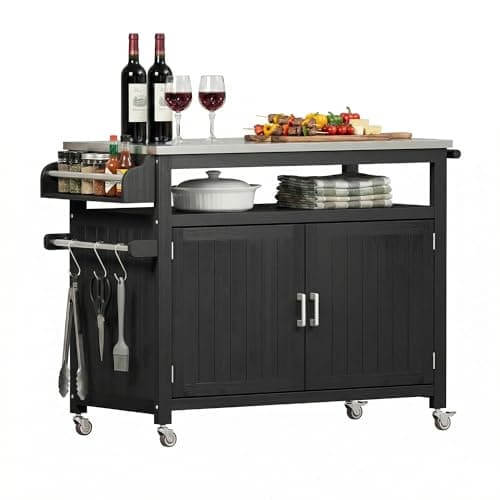
FUQARHY 43.3-Inch Outdoor Kitchen Island with Storage Cabinet and Stainless Steel Top, Solid Wood Prep Station Grill Table with Lockable Wheels for Patio, Backyard, Party (Black)
See price on Amazon
Check price on Amazon: FUQARHY 43.3-Inch Outdoor Kitchen Island with Storage Cabinet and Stainless Steel Top, Solid Wood Prep Station Grill Table with Lockable Wheels for Patio, Backyard, Party (Black)Keter Unity XL Portable Outdoor Table with Stainless Steel Top for Kitchen Prep and Outdoor Storage Cabinet for Grilling Accessories, Dark Grey
$237.99
Check price on Amazon: Keter Unity XL Portable Outdoor Table with Stainless Steel Top for Kitchen Prep and Outdoor Storage Cabinet for Grilling Accessories, Dark GreyFeasto Outdoor Grill Cart with Storage Cabinet and Stainless Steel Top, 35-Inch Outdoor Grill Station with Door, Modular Kitchen Island for Food Prep and BBQ, Black & Silver
$229.00
Check price on Amazon: Feasto Outdoor Grill Cart with Storage Cabinet and Stainless Steel Top, 35-Inch Outdoor Grill Station with Door, Modular Kitchen Island for Food Prep and BBQ, Black & SilverFeasto Outdoor Kitchen Island with Cabinet, Outdoor Grill Table with Stainless Steel Top for Pizza Oven& Griddles, Movable Bar Cart with Pull-Out Plate for Parties& Gathering, Heavy-Duty, L74”x W24”
$259.99
Check price on Amazon: Feasto Outdoor Kitchen Island with Cabinet, Outdoor Grill Table with Stainless Steel Top for Pizza Oven& Griddles, Movable Bar Cart with Pull-Out Plate for Parties& Gathering, Heavy-Duty, L74”x W24”98 Inches Outdoor Kitchen Island, 4-Burner 72000 BTU Propane Stainless Steel BBQ with Side/Rear Burners, With Refrigerator and Sink, Rotisserie, Granite Countertops, Storage, For Backyard BBQ, Silver
$3,652.00
Check price on Amazon: 98 Inches Outdoor Kitchen Island, 4-Burner 72000 BTU Propane Stainless Steel BBQ with Side/Rear Burners, With Refrigerator and Sink, Rotisserie, Granite Countertops, Storage, For Backyard BBQ, SilverKeter Outdoor Rolling Table Cart for Food Prep, Storage, Bar & Grill, Dark Brown - Portable Kitchen Island Tabletop with Wheels for Drinks, Snacks, and Cooking
See price on Amazon
Check price on Amazon: Keter Outdoor Rolling Table Cart for Food Prep, Storage, Bar & Grill, Dark Brown - Portable Kitchen Island Tabletop with Wheels for Drinks, Snacks, and CookingJY QAQA Outdoor Grill Cart with Storage,Patio Kitchen Island Outdoor Grill Table with Wheels,BBQ Cart Movable Pizza Oven Table Stand, Storage Cabinet, Foldable Tabletop, (Black)
$135.98
Check price on Amazon: JY QAQA Outdoor Grill Cart with Storage,Patio Kitchen Island Outdoor Grill Table with Wheels,BBQ Cart Movable Pizza Oven Table Stand, Storage Cabinet, Foldable Tabletop, (Black)FUQARHY 43.3-Inch Outdoor Kitchen Island with Storage Cabinet and Stainless Steel Top, Solid Wood Prep Station Grill Table with Lockable Wheels for Patio, Backyard, Party (Black)
See price on Amazon
Check price on Amazon: FUQARHY 43.3-Inch Outdoor Kitchen Island with Storage Cabinet and Stainless Steel Top, Solid Wood Prep Station Grill Table with Lockable Wheels for Patio, Backyard, Party (Black)Prices and availability are accurate as of October 22, 2026, 11:45 AM UTC and are subject to change.
Prefab The islands: Top Brands and What to Expect
Prefab (prefabricated) the islands arrive as kits with pre-cut components, pre-drilled holes, and step-by-step assembly instructions. The best prefab islands use galvanized steel or aluminum stud framing covered with weather-resistant panels — either cement board for stone veneer application or pre-finished composite panels. Assembly typically requires basic tools (drill, level, wrenches) and takes 4 to 12 hours depending on complexity.
Bull Outdoor Products is one of the most established names in prefab the islands, offering complete island packages that include a built-in grill, access doors, a stainless steel sink, and a finished stucco or rock panel exterior. Their ODK (Outdoor Kitchen) island series starts around $3,500 for a basic 6-foot configuration. RTA Outdoor Living specializes in ready-to-assemble modular islands using lightweight composite panels that snap together without mortar, screws, or special tools — their 8-foot island kit starts around $2,500 (grill not included). Cal Flame offers some of the most feature-rich prefab islands, with packages including grill, side burner, refrigerator, and storage starting around $5,000. The main limitation of prefab islands is fixed sizing — you are locked into the manufacturer's standard dimensions, which may not perfectly fit your patio or accommodate non-standard appliances. However, the speed, lower cost, and DIY-friendly assembly make prefab islands the most popular choice for first-time outdoor kitchen builders. For deeper context on how this connects to a larger build, our main outdoor kitchen setup guide covers every related topic in detail.
Custom-Built The islands: Materials and Construction Methods
A custom-built the island gives you complete control over dimensions, shape, material selection, appliance placement, and architectural style. The three primary construction methods are concrete block (CMU), steel stud framing, and poured concrete, each with different cost and performance characteristics.
Concrete block construction is the most common method for custom the islands. Standard 8-by-8-by-16-inch CMU blocks are stacked and mortared to form the island base, then covered with stone veneer, stucco, tile, or brick. This method is extremely durable — a properly built CMU island can last 50-plus years — and costs roughly $20 to $40 per square foot of wall area for the block work alone. Steel stud framing uses galvanized metal studs (similar to commercial interior walls) sheathed with cement board. This method is lighter than CMU, faster to build, and easier to modify if you need to run electrical or plumbing through the walls. Steel stud islands cost $15 to $30 per square foot for the framing and sheathing. Poured concrete produces monolithic islands with clean, modern lines but requires formwork and is best left to experienced concrete contractors. Total installed cost for a custom the island typically ranges from $150 to $400 per linear foot including base construction, veneer, and countertop — meaning a 10-foot island runs $1,500 to $4,000 for the structure before appliances.
The island Sizing: How to Calculate the Right Dimensions
Proper sizing is critical because an island that is too small cramps your workspace, while one that is too large overwhelms the patio and restricts guest movement. Start with your grill dimensions: measure the width of your built-in grill (or the grill you plan to buy), then add a minimum of 24 inches of countertop space on each side. For a 36-inch grill, that means a minimum island length of 84 inches (7 feet). If you plan to include a sink, add another 24 to 30 inches, and for a refrigerator, add the unit's width plus 2 inches for ventilation clearance.
Standard the island depth is 27 to 30 inches for the base structure, which accommodates a 24-inch-deep cabinet and a countertop overhang of 1.5 to 3 inches on the front and back. If you want bar seating on one side, increase the countertop overhang to 12 to 15 inches on that side and raise it to 42 inches for barstool height. Total island height (base plus countertop) should be 36 inches at the work surface, matching standard kitchen counter height. For clearance, maintain a minimum of 36 inches between the island and any wall, fence, or other structure on all accessible sides — 42 to 48 inches is better for comfort. A popular rule of thumb: your island footprint (including clearances) should not exceed 40 percent of your total patio area, leaving ample room for dining furniture, movement, and landscaping.

Best Countertop Materials for The islands
The countertop is the most visible and most-touched surface on your island, making material selection a critical decision that affects both appearance and functionality. Granite remains the most popular choice, offering natural beauty, exceptional heat resistance (you can place a 500-degree pan directly on it), and excellent scratch resistance. Granite countertops for the islands cost $40 to $100 per square foot installed, with darker colors like Absolute Black and Uba Tuba being the most UV-stable. Seal granite every 12 to 18 months with an impregnating sealer like Bulletproof by StoneTech.
Concrete countertops offer a modern, industrial aesthetic and can be cast in any shape, color, and edge profile. They cost $65 to $135 per square foot and must be sealed with a penetrating sealer plus a topcoat to prevent staining. Dekton and Neolith are sintered stone surfaces made by compressing natural minerals at extreme temperature and pressure. They are virtually indestructible — scratch-proof, stain-proof, UV-stable, and heat-resistant up to 600 degrees Fahrenheit — but cost $80 to $150 per square foot. Porcelain slab countertops (large-format porcelain tiles of 1/2-inch thickness) are an emerging option at $30 to $70 per square foot, offering good durability and a wide range of patterns mimicking marble, wood, and concrete. Avoid marble, limestone, and soapstone outdoors — they are too soft, porous, or reactive for the island use.
Must-Have Features for Your island
Beyond the grill and countertop, the features you build into your island determine how functional and enjoyable the space is for daily use. A built-in sink is arguably the most important accessory after the grill. Even a small 15-by-15-inch bar sink provides essential hand-washing and food-rinsing capability that eliminates constant trips inside. Pair it with a pull-down faucet rated for outdoor use, such as the Delta Leland or Moen Align in a spot-resist stainless finish, costing $150 to $300.
An outdoor-rated refrigerator keeps ingredients and beverages cold at arm's reach. UL-listed outdoor refrigerators from brands like Blaze, Summerset, and True Residential are engineered to operate in ambient temperatures from 38 to 110 degrees Fahrenheit, unlike indoor models that fail above 90 degrees. Expect to pay $800 to $2,500 for a quality 24-inch outdoor undercounter refrigerator. Access doors and drawers provide enclosed storage for utensils, spices, charcoal, and cleaning supplies. Double-door access panels (starting at $150) and triple-drawer units (starting at $300) in 304 stainless steel are the standard. A trash pullout — a slide-out frame that holds a standard 13-gallon trash can behind a cabinet door — keeps waste hidden and costs $100 to $250. Electrical outlets (GFCI-protected, outdoor-rated) built into the island back panel provide power for blenders, phone charging, electric smokers, and lighting.
Utility Requirements: Plumbing, Gas, and Electrical for Outdoor Kitchen Islands
Running utilities to an island requires advance planning, especially for freestanding islands located away from the house. Gas supply for the grill and any side burners requires a dedicated gas line — typically 3/4-inch black iron pipe or corrugated stainless steel tubing (CSST) — run underground from the home's gas meter or an interior shut-off valve. This work must be performed by a licensed plumber or gas fitter and inspected by your local building authority. Costs range from $300 to $1,500 depending on distance and complexity. Size the line based on total BTU demand: a 36-inch grill (60,000 BTU) plus a double side burner (24,000 BTU) plus a warming drawer (16,000 BTU) totals 100,000 BTU, requiring a 3/4-inch supply line for runs up to 50 feet.
Water supply and drainage for a sink requires both a cold water line (hot water is rarely run to outdoor kitchens due to cost and heat loss) and a drain line. The drain must connect to your home's sewer or septic system — never drain an outdoor sink onto the ground or into a storm drain, as most codes prohibit this. Expect $500 to $2,000 for outdoor plumbing installation. Electrical requirements include a minimum of one dedicated 20-amp GFCI-protected circuit for outlets and a separate circuit for the refrigerator (which should never share a circuit with high-draw appliances). Low-voltage lighting can run on a separate transformer. An electrician typically charges $500 to $1,500 for outdoor kitchen electrical work including trenching and conduit installation.
Portable and Modular Outdoor Kitchen Islands for Renters and Small Spaces
Not every outdoor cooking enthusiast owns their home or has the space for a permanent the island. Portable and modular options deliver the outdoor kitchen experience without permanent construction or landlord approval issues. Portable grill carts with integrated prep surfaces, storage cabinets, and condiment racks function as mini the islands that can be wheeled into a garage or storage shed when not in use. The Weber Traveler Portable Gas Grill (around $350) and the Blackstone 36-inch Griddle with hood and cart (around $400) are popular freestanding options.
For a more substantial setup, modular the island systems assemble without permanent fasteners and can be disassembled for moving. RTA Outdoor Living offers modular islands that connect with a cam-lock system — no mortar, no screws, no tools — and disassemble in under an hour. Prices start around $2,000 for a basic L-shape module set. Stoll Industries makes portable the islands on casters with folding side shelves that expand from a compact 30-by-24-inch storage footprint to a full 72-by-30-inch cooking station. For apartment balconies and condo patios, compact electric grills like the Weber Pulse 2000 (around $500) combined with a rolling butcher block cart create a functional two-piece the island in a footprint of just 4 by 2 feet. Always check your HOA rules, lease terms, and local fire codes before placing any grill on a balcony or in a shared outdoor space.
Outdoor Kitchen Island Maintenance and Winterization
Regular maintenance keeps your island looking and functioning like new for 15 to 30 years. Stone veneer surfaces should be inspected annually for cracked mortar joints, which allow water infiltration that causes freeze-thaw damage in cold climates. Repair any cracks with color-matched exterior-grade mortar. Stucco finishes should be checked for hairline cracks and sealed with elastomeric caulk to prevent water penetration behind the stucco layer, which leads to steel stud corrosion or mold growth on cement board sheathing.
Countertop maintenance varies by material: seal granite every 12 to 18 months, seal concrete every 6 to 12 months, and clean Dekton or porcelain with a pH-neutral cleaner (no harsh chemicals needed). For winterization in freeze-prone climates, the process involves shutting off the water supply valve, opening the outdoor faucet to drain the line, disconnecting and draining the sink's P-trap, and blowing compressed air through the water line to clear residual water. Shut off the gas supply at the outdoor shut-off valve and disconnect the regulator. Cover the grill with a fitted cover, and cover the entire island with a full outdoor kitchen cover — heavy-duty polyester covers from brands like Coverstore and Classic Accessories cost $150 to $400 depending on island size. Remove any items that can freeze and crack (glass bottles, sealed liquids) and prop open cabinet doors slightly to allow air circulation and prevent mildew buildup during extended closure.
Where the clearance and sizing figures above matter to safety or to a permit, verify them against the kitchen sizing standards published by the National Kitchen & Bath Association rather than against any single guide.
Frequently Asked Questions
01How much does an outdoor kitchen island cost?
02Is a prefab or custom outdoor kitchen island better?
03What size should my outdoor kitchen island be?
04What is the best countertop for an outdoor kitchen island?
05Do I need a permit to build an outdoor kitchen island?
06Can I build an outdoor kitchen island myself?
07What is the best base material for an outdoor kitchen island?
08How do I run gas and water to a freestanding outdoor kitchen island?
09How long does it take to build an outdoor kitchen island?
10Should my outdoor kitchen island have a sink?
This guide is part of Outdoor Kitchen Components: What Goes In, In What Order, and What to Skip — the hub covering every components guide on Outdoor Kitchen Setup.
Related Guides
Written and edited by Sukie
Sukie is the editor behind Outdoor Kitchen Setup. They compile manufacturer specification sheets, published building codes, and industry sizing standards into the measurement and planning guides on this site, and check every figure against its original source before it goes live. Where a number varies by brand or by local code, the guides say so rather than presenting a single figure as universal.