Prefab Outdoor Kitchen: Best Ready-to-Assemble Islands for 2026
Prefab outdoor kitchen islands compared: RTA modular sets, Bull turnkey configurations, Challenger U-shapes, delivery freight tips,
By Sukie
Editor · compiles manufacturer specs and building-code references into the measurement guides on this site
A prefab outdoor kitchen is the fastest and most affordable way to add a fully functional cooking station to your backyard without the time, expense, and complexity of a custom build. Prefabricated outdoor kitchen islands arrive at your home partially or fully assembled, with steel framing, cement board sheathing, and pre-cut appliance openings already completed at the factory. Instead of waiting weeks for contractors to pour a concrete pad, frame an island, apply stone veneer, and install a countertop, a prefab outdoor kitchen can go from delivery truck to first cookout in as little as one afternoon. In 2026, the prefab market has matured significantly, with brands like Bull Outdoor Products, RTA Outdoor Living, Summerset Professional Grills, and Challenger Designs offering islands that rival custom builds in both appearance and durability. Prices range from $2,500 for a compact single-grill island to $15,000 or more for L-shaped or U-shaped configurations with multiple appliances. The modular nature of many prefab systems also means you can start with a basic grill island and expand over time by adding matching side modules for sinks, refrigerators, or storage. This guide covers everything you need to know about choosing, ordering, receiving, and setting up a prefab outdoor kitchen, including the top brands, construction quality differences, customization options, and potential pitfalls to avoid.
Top Picks: Best Prefab Outdoor Kitchen: Best Ready-to-Assemble Islands for 2026 in 2026
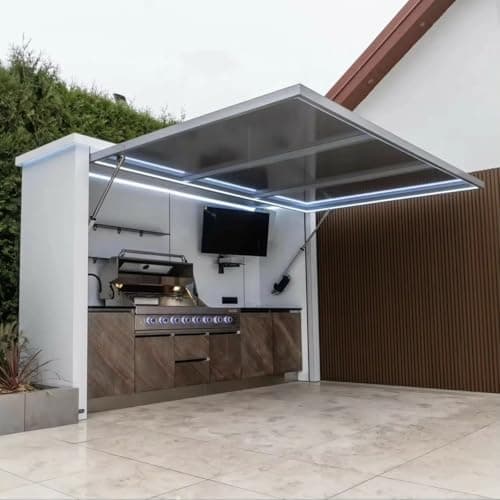
Prefab Outdoor Kitchen Pod – Stainless Steel BBQ Grill Cabinet, Modular Weatherproof Garden & Patio Cooking Station for Family BBQ, Summer Entertaining and Coastal Areas
$5,190.00
Shop Now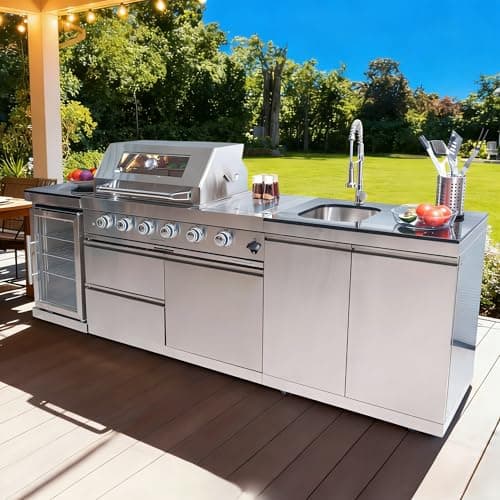
98 Inches Outdoor Kitchen Island, 4-Burner 72000 BTU Propane Stainless Steel BBQ with Side/Rear Burners, With Refrigerator and Sink, Rotisserie, Granite Countertops, Storage, For Backyard BBQ, Silver
$3,652.00
Shop Now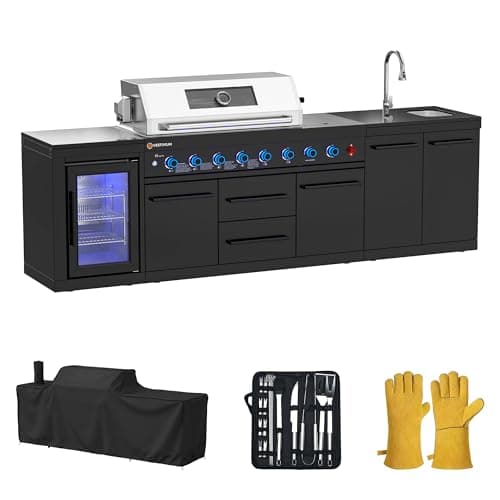
VESTIVIUM 112" All-in-One Outdoor Kitchen, 8-Burner Modular Grill Station, Powder Coating Black SS304 & Black Granite, Sink, Fridge, Complete BBQ Set for Large Patios & Backyards (Propane)
$5,599.00
Shop Now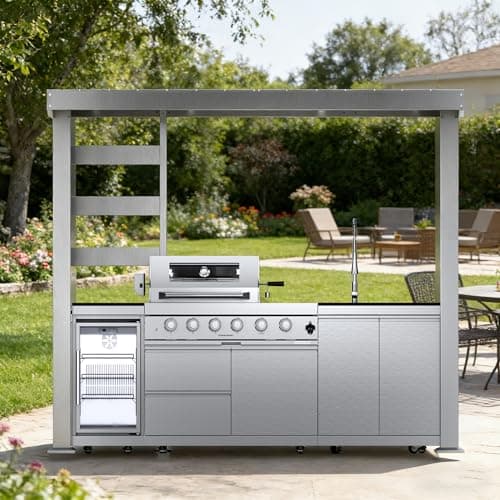
keainvren Prefab Outdoor Kitchen Kits, 6-Burner Barbecue Grill Island with Refrigerator & Rotisserie, All in One Kitchenette & Outdoor Prep Station for Backyard (Silver(110"), Propane Gas)
$7,099.00
Shop Now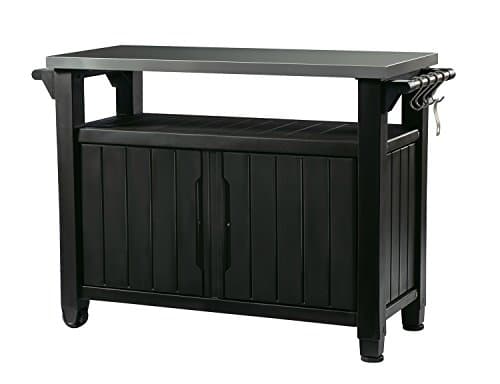
Keter Unity XL Portable Outdoor Table with Stainless Steel Top for Kitchen Prep and Outdoor Storage Cabinet for Grilling Accessories, Dark Grey
$220.99
Shop Now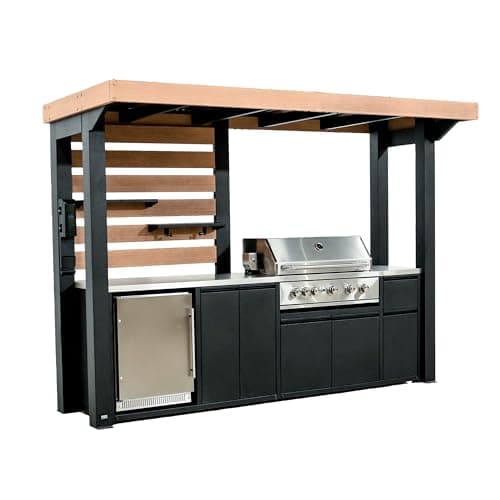
Backyard Discovery Fusion Flame Galvanized Steel Covered Outdoor Kitchen with 5-Burner Stainless, Grill, Refrigerator, Countertop, Storage, and, Roof for All-Season Outdoor Cooking, electric
$4,999.00
Shop Now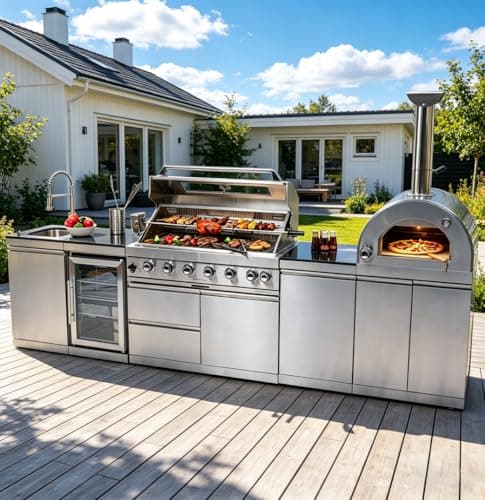
128-Inch Stainless Steel Outdoor Kitchen Island, Propane BBQ Grill with Pizza Oven, Rotisserie, Refrigerator, Granite Countertop, Storage Cabinets & Drawers 120,000 BTU
$6,999.99
Shop Now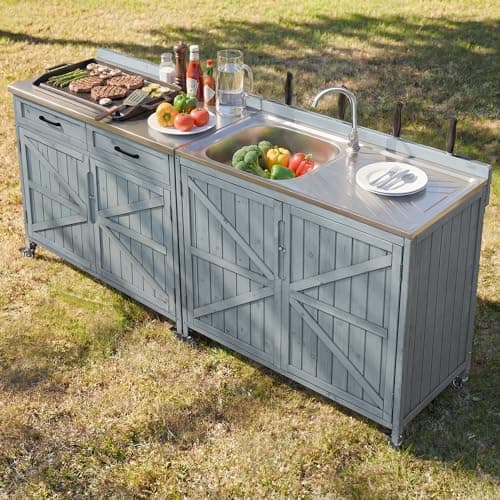
Merax 2 Piece Modular Outdoor Kitchen Series- Kitchen Grill Cart w/Stainless Steel Sink, Wood Rolling BBQ Prep Table w/Stainless Steel Top, Lockable Wheels for Patio & Outdoor Cooking, Grey Blue
$529.99
Shop NowPrefab Outdoor Kitchen Pod – Stainless Steel BBQ Grill Cabinet, Modular Weatherproof Garden & Patio Cooking Station for Family BBQ, Summer Entertaining and Coastal Areas
$5,190.00
Shop Now98 Inches Outdoor Kitchen Island, 4-Burner 72000 BTU Propane Stainless Steel BBQ with Side/Rear Burners, With Refrigerator and Sink, Rotisserie, Granite Countertops, Storage, For Backyard BBQ, Silver
$3,652.00
Shop NowVESTIVIUM 112" All-in-One Outdoor Kitchen, 8-Burner Modular Grill Station, Powder Coating Black SS304 & Black Granite, Sink, Fridge, Complete BBQ Set for Large Patios & Backyards (Propane)
$5,599.00
Shop Nowkeainvren Prefab Outdoor Kitchen Kits, 6-Burner Barbecue Grill Island with Refrigerator & Rotisserie, All in One Kitchenette & Outdoor Prep Station for Backyard (Silver(110"), Propane Gas)
$7,099.00
Shop NowKeter Unity XL Portable Outdoor Table with Stainless Steel Top for Kitchen Prep and Outdoor Storage Cabinet for Grilling Accessories, Dark Grey
$220.99
Shop NowBackyard Discovery Fusion Flame Galvanized Steel Covered Outdoor Kitchen with 5-Burner Stainless, Grill, Refrigerator, Countertop, Storage, and, Roof for All-Season Outdoor Cooking, electric
$4,999.00
Shop Now128-Inch Stainless Steel Outdoor Kitchen Island, Propane BBQ Grill with Pizza Oven, Rotisserie, Refrigerator, Granite Countertop, Storage Cabinets & Drawers 120,000 BTU
$6,999.99
Shop NowMerax 2 Piece Modular Outdoor Kitchen Series- Kitchen Grill Cart w/Stainless Steel Sink, Wood Rolling BBQ Prep Table w/Stainless Steel Top, Lockable Wheels for Patio & Outdoor Cooking, Grey Blue
$529.99
Shop NowWhat Exactly Is a Prefab Outdoor Kitchen?
An outdoor kitchen, also called a ready-to-assemble or RTA outdoor kitchen, is an island structure manufactured in a factory and shipped to your home for final assembly and appliance installation on-site. Unlike fully custom outdoor kitchens where every component is built from scratch by a contractor on your property, prefab islands use standardized dimensions and pre-engineered components that snap, bolt, or screw together following detailed instructions. The typical outdoor kitchen consists of a steel or aluminum frame, cement board or composite panel sheathing, a pre-formed countertop made from granite, porcelain, or concrete, and pre-cut openings sized for specific grill models and accessories.
There are two main subcategories within the prefab market. Fully assembled islands ship as a single large unit on a pallet, requiring only that you place the island, drop in your appliances, and connect gas and electric. These are the easiest to set up but are limited in size by shipping constraints, usually maxing out at about eight feet long. Modular or knock-down kits ship as flat-packed panels that you assemble on-site, typically in two to six hours with basic tools. These can be configured in straight, L-shaped, or U-shaped layouts and can reach 12 feet or longer. Both types use non-combustible, weather-resistant materials designed to last 15 to 25 years outdoors with minimal maintenance, making them a practical alternative to the $15,000 to $40,000 price tags of fully custom masonry outdoor kitchens. Pair this guide with our broader outdoor kitchen setup overview for a complete picture of how this fits into a full backyard build.
Top Prefab Outdoor Kitchen Brands Compared
Bull Outdoor Products is one of the most recognized names in the outdoor kitchen space. Their island packages range from the compact Angus Island at around $4,200 to the expansive Brahma Island at roughly $5,500, all featuring galvanized steel frames, stucco finish, and tile countertops. Bull islands include matching Bull grills, but the cutouts are sized to accept most major grill brands if you prefer a different model. Build quality is solid, and replacement parts are widely available through authorized dealers and Amazon.
RTA Outdoor Living specializes exclusively in modular ready-to-assemble islands and has built a strong reputation for design flexibility. Their system uses interlocking aluminum frames with composite panels that resist moisture, termites, and fire. Prices start around $3,800 for a six-foot straight island and go up to $14,000 for a 12-foot L-shaped configuration with space for a grill, side burner, refrigerator, and sink. What sets RTA apart is their extensive finish options, including realistic stone, wood-look, and modern smooth textures. Summerset Professional Grills offers their Majestic Series islands starting near $6,000, built with heavy 16-gauge steel and real granite countertops. Challenger Designs targets the mid-range market with powder-coated steel islands featuring a quick-connect assembly system that genuinely goes together in under three hours. Their Coastal Series, priced from $4,500, includes marine-grade hardware for waterfront properties. When comparing brands, pay close attention to frame gauge, countertop material, warranty length, and whether appliances are included or sold separately.
Outdoor kitchen Layouts and Configurations
The layout of your outdoor kitchen depends on your available space, cooking needs, and the number of appliances you want to incorporate. The most common configuration is the straight island, which ranges from five to ten feet long and accommodates a grill plus one or two additional features like a side burner or access doors. Straight islands work well against a wall, along a fence line, or as a freestanding element in the center of a patio. They require the least space and are the most affordable, typically ranging from $2,500 to $7,000 depending on length and finishes.
An L-shaped outdoor kitchen adds a perpendicular wing to the main island, creating a natural work triangle and providing room for four to six appliances. The L-shape also creates a social barrier that separates the cooking zone from the dining and lounging area while still allowing the cook to face guests. Expect to pay $6,000 to $14,000 for a quality L-shaped prefab setup. U-shaped configurations are the largest, wrapping around the cook on three sides and providing maximum counter space and storage. These are best suited for patios at least 12 by 14 feet and typically cost $10,000 to $18,000 in prefab form. Some brands, including RTA Outdoor Living and Challenger Designs, also offer island-plus-bar configurations that add a raised bar-height countertop on one side with an overhang for bar stools, effectively turning your outdoor kitchen into an outdoor bar and grill in one unit.
Delivery, Assembly, and Setup of a Prefab Outdoor Kitchen
Understanding the delivery and assembly process before you order an outdoor kitchen prevents surprises and ensures a smooth installation. Most prefab islands ship via freight carrier on a wooden pallet, with total package weights ranging from 400 pounds for a compact island to over 1,500 pounds for a large L-shaped or U-shaped system. Freight delivery means a semi-truck or box truck will pull up to your home, and you are typically responsible for moving the pallet from the curb or driveway to the final location. Some manufacturers offer white-glove delivery for an additional $300 to $800, where the delivery team places the island in your backyard. Given the weight, this upgrade is often worth every penny.
Assembly complexity varies by brand. Fully assembled islands from Bull require minimal setup: place the island, level it using adjustable feet, drop in the grill and accessories, and connect the gas line. Total time is about one to two hours. Modular knock-down kits from RTA Outdoor Living or Challenger Designs involve bolting frame sections together, attaching panel skins, and placing the countertop sections, which typically takes three to six hours with two people and basic tools like a socket wrench set, level, and drill. A flat, level surface is essential for any outdoor kitchen. Concrete patios, paver patios, and compacted gravel pads all work. Bare grass or uneven ground does not, as the island will shift and crack over time. If your patio is not level, use composite shims under the island feet to achieve a level installation. Once positioned, have a licensed plumber connect the gas line and a licensed electrician handle any electrical connections for outlets, lighting, or refrigerators.
Customizing Your Prefab Outdoor Kitchen After Purchase
One of the biggest advantages of an outdoor kitchen is how easily you can customize it to suit your specific needs, both at the time of order and after the island is installed. Most manufacturers offer finish options that let you match your home's exterior aesthetic. RTA Outdoor Living provides over 30 panel finishes ranging from coral stone to weathered wood to sleek modern gray, applied to their composite panels at the factory. Bull and Summerset islands come with a stucco base coat that you can paint or apply thin stone veneer over to achieve a custom look at a fraction of the cost.
After installation, there are numerous modifications you can make without voiding the warranty on most prefab islands. Adding appliances is the most common customization. If your island came with only a grill cutout, you can have a contractor cut additional openings for a side burner, sink, or trash pullout using a carbide-tipped hole saw or angle grinder. Most prefab islands use cement board sheathing that cuts cleanly with standard construction tools. Upgrading the countertop is another popular modification. Many homeowners start with the standard tile or concrete countertop included in the package and later upgrade to a slab of granite or quartzite, which a local stone fabricator can template and install in a week for $800 to $2,500 depending on the stone and size. You can also add pergola posts, undercounter lighting, electrical outlets, and backsplash tile to personalize the space. The key is that the prefab island provides a solid, weather-resistant structure that serves as a reliable foundation for whatever upgrades you envision down the road.
Prefab Outdoor Kitchen vs Custom Build: Cost and Quality Breakdown
The decision between an outdoor kitchen and a fully custom build comes down to budget, timeline, design flexibility, and how much you value uniqueness. A custom outdoor kitchen starts with an empty patio and a blank canvas. A contractor builds the island frame from steel studs or concrete block, sheathes it, applies your chosen finish, fabricates a countertop to your exact specifications, and installs every appliance and fixture. The result is a one-of-a-kind structure that fits your space perfectly, but the cost is significant. Custom outdoor kitchens average $15,000 to $40,000 for a mid-range build, with premium builds exceeding $75,000. Construction timelines run three to eight weeks, and you are dependent on contractor availability, weather delays, and material lead times.
A outdoor kitchen in a comparable eight-foot straight configuration with a built-in grill, side burner, access doors, and granite countertop costs $4,000 to $8,000, roughly 40 to 60 percent less than a custom equivalent. The timeline from order to cooking is two to four weeks, including shipping. Build quality on reputable prefab brands has improved dramatically, with many using the same 16-gauge galvanized steel frames and cement board sheathing as custom builders. The trade-off is less design flexibility. You are working within the manufacturer's standard dimensions and layout options, which may not perfectly fit an oddly shaped patio or integrate seamlessly with an existing structure. For most homeowners, an outdoor kitchen delivers 85 to 90 percent of the custom experience at roughly half the cost and a quarter of the build time, making it the practical choice for the majority of backyard projects.
Common Mistakes to Avoid When Buying a Prefab Outdoor Kitchen
The outdoor kitchen market has grown rapidly, and not every product delivers on its promises. Knowing the most common mistakes buyers make helps you avoid costly regrets. Mistake one: ignoring the weight and access path. A prefab island on a pallet can weigh 500 to 1,500 pounds. Before ordering, measure every gate, side yard, and walkway between your driveway and the patio to confirm the island can physically get there. Many homeowners have been forced to disassemble fences or hire a crane because they never checked clearances. Mistake two: skipping the level check. Placing a prefab island on an uneven surface leads to cracking countertops, misaligned doors, and structural stress over time. Use a four-foot level to check your patio in both directions before delivery day.
Mistake three: assuming appliances are included. Many outdoor kitchen packages advertise a specific price but include only the island structure, not the grill, refrigerator, or side burner. Read the product listing carefully to understand exactly what ships in the box. Mistake four: choosing the cheapest option without checking materials. Budget islands under $2,000 sometimes use wood framing, thin aluminum panels, or MDF-core components that deteriorate rapidly outdoors. Always confirm the frame is galvanized steel, the sheathing is cement board or marine-grade composite, and the countertop is rated for outdoor use. Mistake five: forgetting about utilities. A prefab island is just a shell until you connect gas, water, and electric. Budget $500 to $2,000 for utility hookups depending on how far your island sits from existing gas and water lines. Having utility locations mapped before you choose your island placement can save hundreds in installation costs by minimizing pipe and wire runs.
Long-Term Maintenance and Durability of Prefab Outdoor Kitchens
A well-built outdoor kitchen requires remarkably little maintenance to look and function great for 15 to 25 years. The galvanized steel frames used by reputable manufacturers resist rust and corrosion even in humid coastal climates, and cement board sheathing does not rot, warp, or attract insects like wood. Your primary maintenance tasks center on the finish and countertop. Stucco finishes should be inspected annually for hairline cracks, which can be filled with exterior-grade elastomeric caulk to prevent water infiltration. Stone veneer panels should be checked for loose pieces, especially after freeze-thaw cycles, and re-adhered with outdoor construction adhesive as needed.
For granite countertops, apply a penetrating sealer every 12 to 18 months using a product like StoneTech BulletProof or Tuff Duck, which takes about 30 minutes and costs under $30 in materials. Porcelain countertops require no sealing but should be cleaned with a non-abrasive cleaner to prevent buildup. Stainless steel appliances and doors should be wiped down monthly with a stainless steel cleaner applied with a microfiber cloth, always rubbing with the grain. In coastal areas within 20 miles of saltwater, increase this to weekly to prevent salt corrosion, and consider upgrading to 316-grade marine stainless steel appliances if available. Invest in a fitted island cover to protect the entire structure during periods of non-use, especially in winter. Brands like Covermates and Classic Accessories offer custom-sized outdoor kitchen covers for $150 to $400 that shield against rain, snow, UV damage, and fallen debris. With these simple maintenance habits, your outdoor kitchen will remain structurally sound and visually appealing for decades.
For the sizing and clearance figures in this guide, the planning standards published by the National Kitchen & Bath Association is the primary reference — and your inspector is the one who decides.
Frequently Asked Questions
01How much does a prefab outdoor kitchen cost?
02Can I assemble a prefab outdoor kitchen myself?
03What is the difference between prefab and modular outdoor kitchens?
04How long does a prefab outdoor kitchen last?
05Do prefab outdoor kitchens come with a warranty?
06What surface should a prefab outdoor kitchen sit on?
07Can I move a prefab outdoor kitchen after installation?
08Are prefab outdoor kitchens weatherproof?
09What is the best prefab outdoor kitchen brand?
10Do I need a permit for a prefab outdoor kitchen?
This guide is part of Outdoor Kitchen Types: Choosing Between Built-In, Modular, Prefab, and Portable — the hub covering every kitchen types guide on Outdoor Kitchen Setup.
Related Guides
Written and edited by Sukie
Sukie is the editor behind Outdoor Kitchen Setup. They compile manufacturer specification sheets, published building codes, and industry sizing standards into the measurement and planning guides on this site, and check every figure against its original source before it goes live. Where a number varies by brand or by local code, the guides say so rather than presenting a single figure as universal.