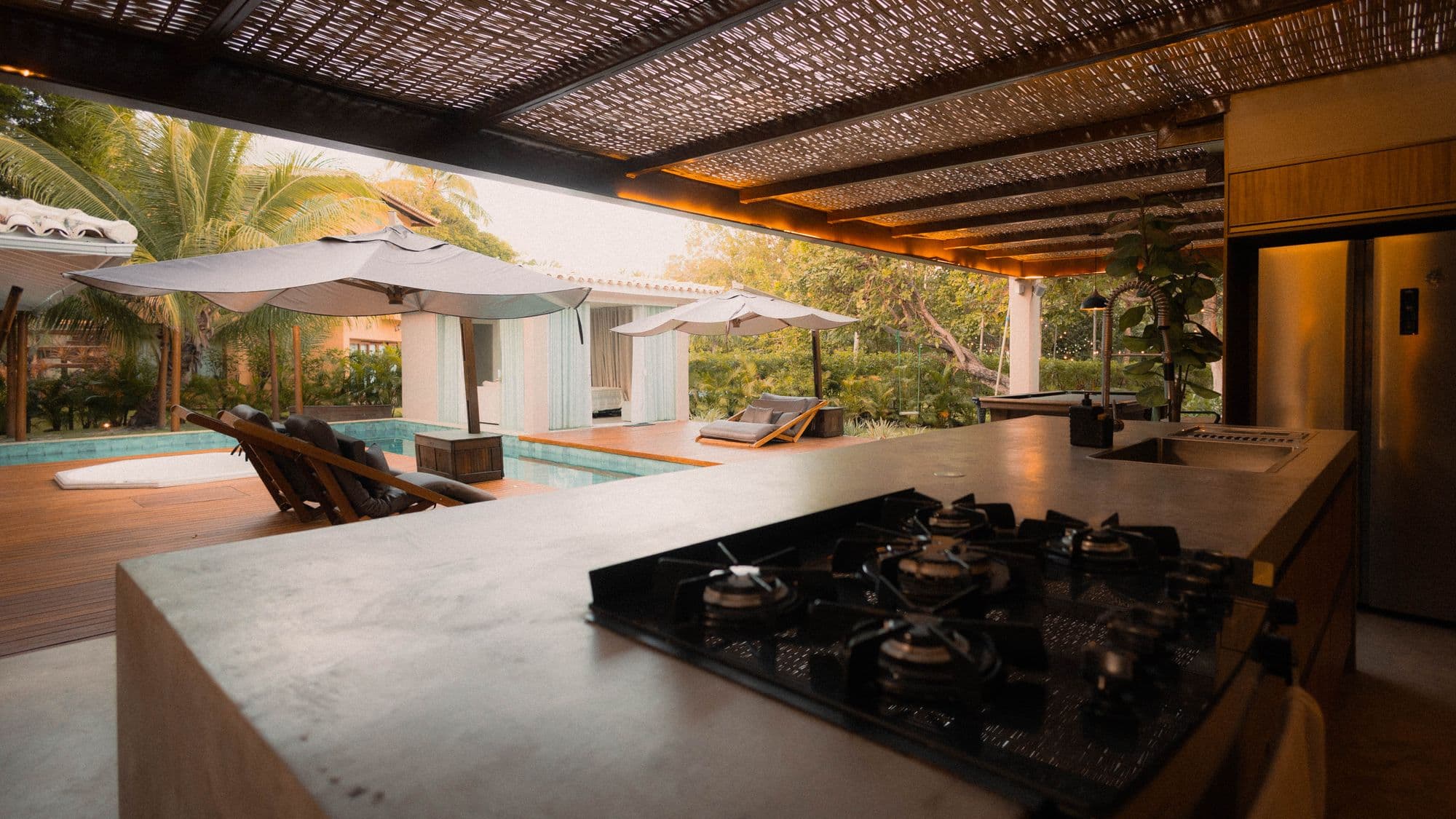
Covered Outdoor Kitchen Plans
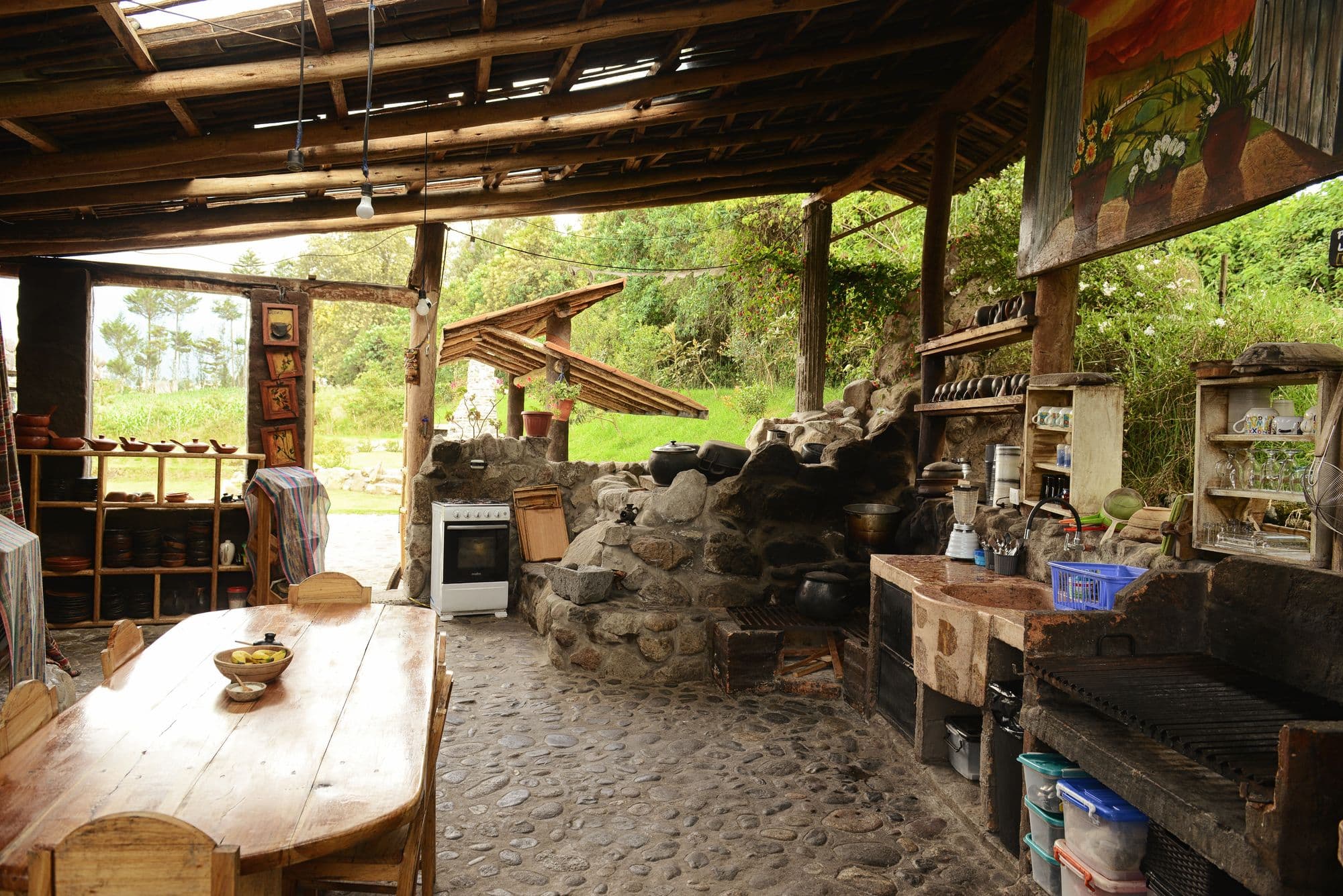
Covered outdoor kitchen plans get more technical than open-air builds because the moment a roof goes over a grill you have entered the territory of building codes, mechanical ventilation, drainage engineering, and combustible-clearance math.
Photo: Alef Morais / Pexels (Pexels License)
Top picks for this build
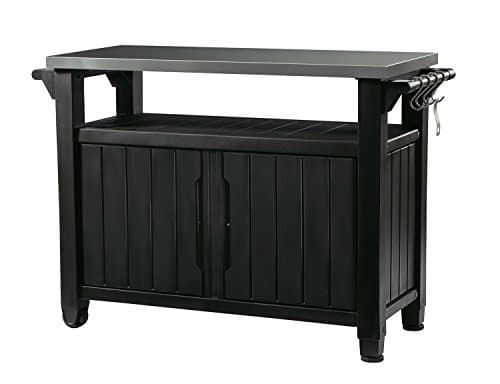
Keter Unity XL Portable Outdoor Table with Stainless Steel Top for Kitchen Prep and Outdoor Storage Cabinet for Grilling Accessories, Dark Grey
$237.99
Check price on Amazon: Keter Unity XL Portable Outdoor Table with Stainless Steel Top for Kitchen Prep and Outdoor Storage Cabinet for Grilling Accessories, Dark Grey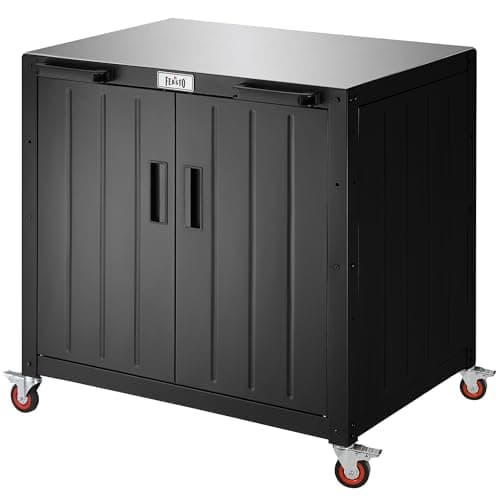
Feasto Outdoor Grill Cart with Storage Cabinet and Stainless Steel Top, 35-Inch Outdoor Grill Station with Door, Modular Kitchen Island for Food Prep and BBQ, Black & Silver
$229.00
Check price on Amazon: Feasto Outdoor Grill Cart with Storage Cabinet and Stainless Steel Top, 35-Inch Outdoor Grill Station with Door, Modular Kitchen Island for Food Prep and BBQ, Black & Silver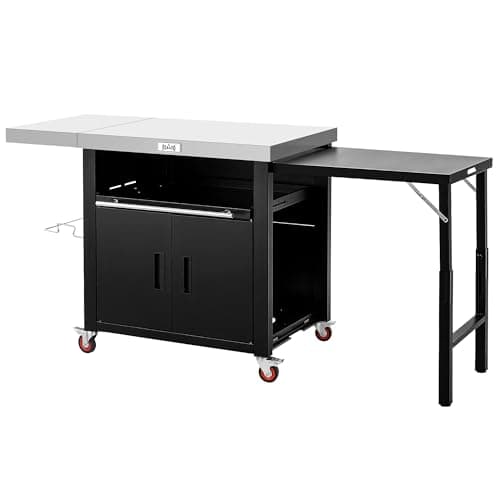
Feasto Outdoor Kitchen Island with Cabinet, Outdoor Grill Table with Stainless Steel Top for Pizza Oven& Griddles, Movable Bar Cart with Pull-Out Plate for Parties& Gathering, Heavy-Duty, L74”x W24”
$259.99
Check price on Amazon: Feasto Outdoor Kitchen Island with Cabinet, Outdoor Grill Table with Stainless Steel Top for Pizza Oven& Griddles, Movable Bar Cart with Pull-Out Plate for Parties& Gathering, Heavy-Duty, L74”x W24”Keter Unity XL Portable Outdoor Table with Stainless Steel Top for Kitchen Prep and Outdoor Storage Cabinet for Grilling Accessories, Dark Grey
$237.99
Check price on Amazon: Keter Unity XL Portable Outdoor Table with Stainless Steel Top for Kitchen Prep and Outdoor Storage Cabinet for Grilling Accessories, Dark GreyFeasto Outdoor Grill Cart with Storage Cabinet and Stainless Steel Top, 35-Inch Outdoor Grill Station with Door, Modular Kitchen Island for Food Prep and BBQ, Black & Silver
$229.00
Check price on Amazon: Feasto Outdoor Grill Cart with Storage Cabinet and Stainless Steel Top, 35-Inch Outdoor Grill Station with Door, Modular Kitchen Island for Food Prep and BBQ, Black & SilverFeasto Outdoor Kitchen Island with Cabinet, Outdoor Grill Table with Stainless Steel Top for Pizza Oven& Griddles, Movable Bar Cart with Pull-Out Plate for Parties& Gathering, Heavy-Duty, L74”x W24”
$259.99
Check price on Amazon: Feasto Outdoor Kitchen Island with Cabinet, Outdoor Grill Table with Stainless Steel Top for Pizza Oven& Griddles, Movable Bar Cart with Pull-Out Plate for Parties& Gathering, Heavy-Duty, L74”x W24”Prices and availability are accurate as of October 22, 2026, 11:45 AM UTC and are subject to change.
Choosing Roof Style: Shed vs Gable vs Hip for Covered Outdoor Kitchen Plans
Most covered outdoor kitchen plans land on one of three roof styles, and the choice cascades into framing, cost, and weather performance. A shed roof is a single sloped plane (typically 3:12 to 4:12 pitch) that drains to one side. It is the simplest to frame, uses the fewest rafters, and is the natural choice when the kitchen is built against an existing house wall — the high side ledgers into the house and the low side rests on a beam. Material cost runs $40 to $55 per square foot.
A gable roof has two slopes meeting at a ridge beam, drains to two sides, and reads more architectural. It costs $55 to $75 per square foot for a freestanding 14x16 footprint and adds about 25 percent more lumber than a shed roof. A hip roof has four slopes meeting at a ridge or peak, sheds wind from any direction, and is the right call in coastal hurricane zones (rated for higher uplift in IRC Table R301.2). Hip roofs run $70 to $90 per square foot and need significantly more cuts and angle work, which is why most DIY covered outdoor kitchen plans default to shed or simple gable framing. Pair this guide with the broader information available on our outdoor kitchen content hub for further reading.
Post Sizing, Footing Depth, and Wind-Load Calculations
The four (sometimes six) posts holding up a covered outdoor kitchen carry both gravity loads (the dead weight of the roof) and lateral loads (wind pressure trying to push it sideways). For a 14x16 shed roof in a 100-mph design wind zone, IRC AWC tables call for 6x6 pressure-treated posts (Southern yellow pine, Use Category 4B) on 4-foot spacing maximum. Skip 4x4s — they fail the deflection test on any roof bigger than 8x10.
Post bases sit on concrete piers, not directly on grade. Dig 12-inch-diameter pier holes to 6 inches below your local frost line (typically 24 to 48 inches deep in the northern half of the country), drop a Sonotube form, set rebar cages, and pour 3,000 PSI concrete with a Simpson Strong-Tie ABU66Z post base embedded in the wet pour. The post base lifts the wood end-grain off the concrete, which is the single most important detail for preventing rot — a buried or surface-mounted post will fail at the base within 8 to 12 years no matter the species. For hip and gable roofs in coastal zones, doubled 6x6 posts at the corners (effectively 12x6) handle the increased uplift demand.
Combustible Clearances: 24-Inch Rule and the Code-Required Hood
The most-violated requirement in covered outdoor kitchen plans is overhead clearance to combustibles. International Mechanical Code Section 507 and most grill manufacturer manuals (Lynx, Bull, Blaze, DCS) specify a minimum of 24 inches between the top of the grill hood (in its open position) and the lowest combustible surface above it — rafters, decking, ceiling. For a 36-inch built-in grill mounted with the hood at 39 inches above the floor, the open hood is around 60 inches up, which means your roof structure must be at least 84 inches (7 feet) above the grill location. This typically pushes ceiling height to 9 or 10 feet for the rest of the structure, which is why covered outdoor kitchens look taller than typical patios.
If you cannot achieve the 24-inch clearance, you have two options: install a non-combustible material directly above the grill (cement board, metal panel, or stone tile on metal lath) and reduce the clearance to 6 inches, or install a UL-listed range hood ducted to the exterior. Hood sizing follows IFGC tables: 100 CFM per 10,000 BTU of grill capacity, so a 60,000 BTU grill needs 600 CFM, and a 90,000 BTU grill needs 900 CFM. Most homeowners overspec to 1,200 CFM (Vent-A-Hood B100 or Trade-Wind L7236) for safety margin and faster smoke clearing.
Roof Drainage and Gutter Sizing for Covered Outdoor Kitchens
A 14x16 covered outdoor kitchen has 224 square feet of roof catchment, which during a 1-inch-per-hour rain event sheds about 140 gallons in 60 minutes. Without gutters and downspouts, that water dumps directly onto your patio, your countertops if there is wind-driven angle, and the ground six inches from your post bases — eroding the concrete piers over time. Plan gutters into covered outdoor kitchen plans from day one, never as an afterthought.
For 224 square feet of roof, a 5-inch K-style gutter sized at 1.2 square inches of cross-section per 100 square feet of roof handles the load. Pitch the gutter run 1/4 inch per 10 feet toward the downspout. A single 2x3-inch downspout drains roughly 600 square feet of roof, so one downspout per gable end is sufficient. For shed roofs, run the gutter along the low edge with the downspout at the corner farthest from the patio entrance. Aluminum gutters are the standard ($6 to $8 per linear foot installed) and avoid the rust issues steel develops within five years. Tie downspouts into a buried 4-inch corrugated drain pipe carrying water at least 10 feet from the structure.
Soffit Ventilation and Moisture Management
A covered roof traps warm, humid air against the underside of the decking, and without ventilation that moisture condenses on the cold side of the sheathing during cooler nights — leading to rot, mold, and shortened roof life. Covered outdoor kitchen plans should include continuous screened soffit vents around the perimeter and either ridge venting (for gable roofs) or a static box vent every 20 linear feet (for shed roofs).
Net free vent area calculation: at minimum 1 square inch of vent per square foot of attic space, split equally between intake (soffit) and exhaust (ridge or box). For a 14x16 covered kitchen with a 4:12 shed roof, the cavity volume above the rafters is roughly 75 cubic feet, requiring about 224 square inches of vent area total — 112 at intake, 112 at exhaust. A standard 16-foot run of continuous soffit vent (LP SmartVent or Cor-A-Vent SV-3) provides 100 square inches per linear foot, so any continuous run handles intake easily. For exhaust, a single 14-inch O'Hagin or Air Vent Inc. low-profile ridge vent does the job. Skip plastic soffit panels with stamped pattern vents — they look like real venting but most provide under 4 square inches per linear foot of net free area.
Permit Process and Setbacks for Covered Structures
A covered outdoor kitchen is treated by most jurisdictions as a permanent accessory structure, which means it triggers a building permit, structural plan review, often an electrical permit if outlets and lighting are added, and sometimes a separate gas permit for hard-piped fuel lines. Total permit fees typically run $400 to $1,500 depending on assessed valuation. Plan to submit framing plans showing post sizes, beam spans, rafter sizing per IRC Table R802.5.1, and a footing detail. Stamped engineering is required in some areas (especially coastal Florida and California earthquake zones) and adds $500 to $1,500 to the project.
Setbacks are the second permit-related gotcha. Most municipalities require accessory structures to be set back at least 5 feet from side property lines and 10 feet from the rear, with some HOAs imposing additional 15-foot or 20-foot setbacks. Covered outdoor kitchen plans built against an existing house wall (shed roof ledgered into the band joist) often qualify as a roof extension rather than an accessory structure, which can simplify permitting — but only if the connection is engineered with a flashed ledger board, lag bolts every 16 inches, and a code-compliant ledger detail per IRC R507.9. Always pull permits; an unpermitted covered structure complicates home sales and can trigger removal orders during disclosure-period inspections.
Materials List for a 14x16 Shed-Roof Covered Kitchen
Here is a real materials list for a freestanding 14x16-foot shed-roof covered outdoor kitchen, 9-foot ceiling on the high side, 7-foot on the low side, sized for a Bull or Blaze 36-inch built-in. Concrete: 1.2 cubic yards of 3,000 PSI mix for four piers and four post-base cans ($340 delivered). Lumber: four 6x6x10 pressure-treated posts ($240), two 2x10x16 LVL beams for ledger and outboard support ($280), eleven 2x8x16 PT rafters ($385), 7 sheets of 5/8-inch CDX plywood ($420), 2 squares of architectural asphalt shingles ($240) or upgraded standing-seam metal at $1,200.
Hardware and trim: four Simpson ABU66Z post bases ($60), thirty H1 hurricane ties ($75), one box of structural screws ($45), 30 linear feet of K-style aluminum gutter and two downspouts ($210), continuous soffit venting ($95), tongue-and-groove cedar ceiling for finish ($380). Finishes and painting: two gallons solid stain plus primer ($120). Permit and inspection fees: roughly $850. Materials subtotal lands around $3,690 for the structure alone. Add cabinetry and a built-in grill ($4,200 to $7,800), countertops ($1,800 for granite remnants), gas line and electrical work ($2,100 by licensed pros), and you arrive at the typical $11,800 to $15,500 finished cost for a small covered build.
Lighting, Electrical, and Fan Placement Inside the Covered Space
Covered outdoor kitchen plans need three types of electrical: task lighting over the cooking and prep zones, ambient overhead lighting, and dedicated outlets for appliances. All circuits in this environment must be GFCI-protected per NEC 210.8, all outlets must be weather-resistant (WR rated), and all fixtures must carry a damp or wet location listing. The standard wiring approach uses 12-2 NM-B inside the framing cavity transitioning to liquid-tight flexible metal conduit (LFMC) for any exposed runs.
Lighting layout for a 14x16 space: one 4-foot LED puck or recessed downlight directly above the grill (waterproof IP65, 3000K color temperature), four perimeter pendants or recessed cans for ambient light, and one 52-inch outdoor-rated ceiling fan from Hunter or Minka-Aire (look for the wet location listing) centered in the seating area. The ceiling fan does double duty in covered builds — it pushes smoke out from under the roof structure and keeps mosquitoes off guests. Outlets should be spaced every 6 feet along the back wall above the counter, plus one dedicated 20-amp circuit for the refrigerator and one for any electric warming drawer or pizza oven. Plan one weatherproof 20-amp 240V outlet if a future ice maker or beverage center is in scope.
A few specifics that come up repeatedly:
What roofing material lasts longest over an outdoor kitchen?
Standing-seam metal roofing is the best long-term choice (50-year service life, $7 to $12 per square foot installed). Architectural asphalt shingles run $4 to $6 per square foot and last 25 to 30 years. Both shed water cleanly when paired with proper underlayment and ice-and-water shield at eaves and valleys.
How much does a covered outdoor kitchen cost compared to open-air?
A covered build adds roughly $40 to $90 per square foot of roof area on top of the kitchen budget. A 14x16 shed-roof structure runs about $3,700 in framing materials plus $850 in permits, before any cabinetry, appliances, gas, or electrical. Total finished cost for a covered version typically runs 35 to 50 percent more than an open-air equivalent.
Can I attach a covered outdoor kitchen to my existing house?
Yes, by ledgering a shed roof into the band joist using IRC R507.9 details: a flashed and lag-bolted ledger board with bolts every 16 inches into solid framing, plus proper flashing tucked behind siding to prevent water intrusion. This often simplifies permitting compared to a freestanding accessory structure.
The permit and code requirements on this page are compiled from manufacturer documentation and your local adoption of the International Residential Code; your local building department has the final word.
Frequently Asked Questions
01Do I need a permit for covered outdoor kitchen plans?
02What is the minimum clearance from a grill to the roof above?
03Do I need a vent hood under a covered outdoor kitchen?
04What roof style is best for covered outdoor kitchen plans?
05What size posts do I need for a covered outdoor kitchen?
06How deep should footings be for a covered outdoor kitchen?
07Do I need gutters on a covered outdoor kitchen?
This guide is part of Outdoor Kitchen Build Guides: Planning, Permits, Cost, and Hiring — the hub covering every guides guide on Outdoor Kitchen Setup.
Related Guides
Written and edited by Sukie
Sukie is the editor behind Outdoor Kitchen Setup. They compile manufacturer specification sheets, published building codes, and industry sizing standards into the measurement and planning guides on this site, and check every figure against its original source before it goes live. Where a number varies by brand or by local code, the guides say so rather than presenting a single figure as universal.