
Outdoor Kitchen On Deck
Building an outdoor kitchen on deck is fundamentally different from building one on a concrete patio because every pound of cabinet, every gas line, every embedded ember from the grill creates risks that simply don't exist on slab construction.
Photo: Diana ✨ / Pexels (Pexels License)
Top picks for this build
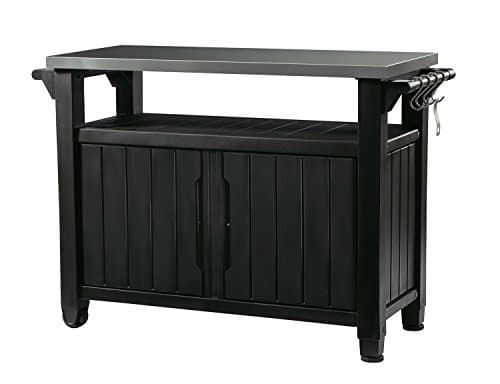
Keter Unity XL Portable Outdoor Table with Stainless Steel Top for Kitchen Prep and Outdoor Storage Cabinet for Grilling Accessories, Dark Grey
$237.99
Check price on Amazon: Keter Unity XL Portable Outdoor Table with Stainless Steel Top for Kitchen Prep and Outdoor Storage Cabinet for Grilling Accessories, Dark Grey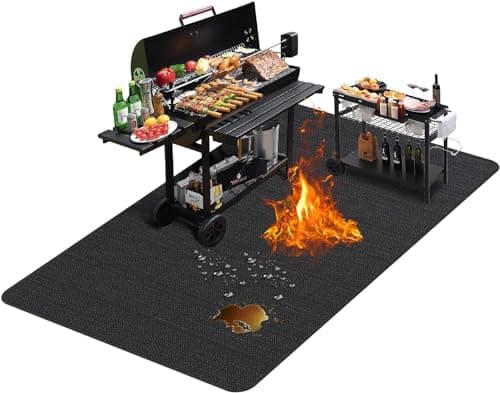
TAOMAND Large 76 x 52 inches Under Grill Mats for Outdoor Grill | Double-Sided Fireproof | Waterproof | Oil-Proof | Easy to Clean | Indoor Fireplace/Fire Pit Mat | Quality BBQ Mat for Deck Patio Lawn
$29.98
Check price on Amazon: TAOMAND Large 76 x 52 inches Under Grill Mats for Outdoor Grill | Double-Sided Fireproof | Waterproof | Oil-Proof | Easy to Clean | Indoor Fireplace/Fire Pit Mat | Quality BBQ Mat for Deck Patio Lawn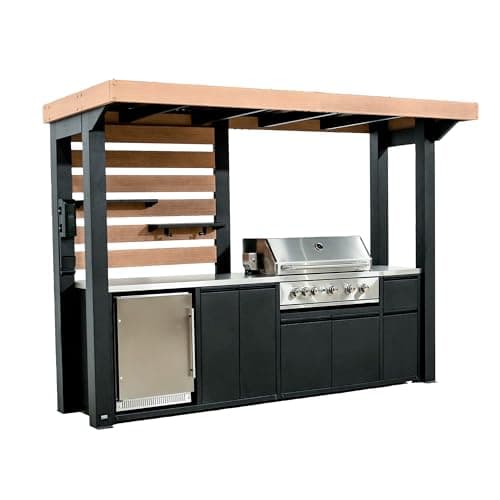
Backyard Discovery Fusion Flame Galvanized Steel Covered Outdoor Kitchen with 5-Burner Stainless, Grill, Refrigerator, Countertop, Storage, and, Roof for All-Season Outdoor Cooking, electric
$4,999.00
Check price on Amazon: Backyard Discovery Fusion Flame Galvanized Steel Covered Outdoor Kitchen with 5-Burner Stainless, Grill, Refrigerator, Countertop, Storage, and, Roof for All-Season Outdoor Cooking, electricKeter Unity XL Portable Outdoor Table with Stainless Steel Top for Kitchen Prep and Outdoor Storage Cabinet for Grilling Accessories, Dark Grey
$237.99
Check price on Amazon: Keter Unity XL Portable Outdoor Table with Stainless Steel Top for Kitchen Prep and Outdoor Storage Cabinet for Grilling Accessories, Dark GreyTAOMAND Large 76 x 52 inches Under Grill Mats for Outdoor Grill | Double-Sided Fireproof | Waterproof | Oil-Proof | Easy to Clean | Indoor Fireplace/Fire Pit Mat | Quality BBQ Mat for Deck Patio Lawn
$29.98
Check price on Amazon: TAOMAND Large 76 x 52 inches Under Grill Mats for Outdoor Grill | Double-Sided Fireproof | Waterproof | Oil-Proof | Easy to Clean | Indoor Fireplace/Fire Pit Mat | Quality BBQ Mat for Deck Patio LawnBackyard Discovery Fusion Flame Galvanized Steel Covered Outdoor Kitchen with 5-Burner Stainless, Grill, Refrigerator, Countertop, Storage, and, Roof for All-Season Outdoor Cooking, electric
$4,999.00
Check price on Amazon: Backyard Discovery Fusion Flame Galvanized Steel Covered Outdoor Kitchen with 5-Burner Stainless, Grill, Refrigerator, Countertop, Storage, and, Roof for All-Season Outdoor Cooking, electricPrices and availability are accurate as of October 22, 2026, 11:45 AM UTC and are subject to change.
Deck Weight Load Limits: Will Your Deck Hold an Outdoor Kitchen?
Before any outdoor kitchen on deck planning, calculate the weight your deck can safely carry. Modern decks built to IRC R301.5 (2018 and later) are designed for a 50 psf live load plus a 10 psf dead load. Pre-2018 decks were sometimes designed to only 40 psf, and older DIY-built decks may be unrated entirely. A 6-foot modular grill island like the Sunstone Designer Series weighs about 800 to 1,200 pounds before granite or quartz countertops add another 350 to 500 pounds. Add a built-in 36-inch grill (140 to 220 pounds), a 24-inch refrigerator (110 to 160 pounds), and contents — and you have 1,800 to 2,500 pounds in roughly 20 to 30 square feet.
To verify capacity, identify the joist span and spacing under your kitchen footprint. A typical residential deck uses 2x10 PT joists at 16-inch on-center over a span of 10 to 14 feet. Span tables from the American Wood Council (AWC DCA-6) tell you the maximum allowable span for 50 psf live load. If your install exceeds the rating, options include sistering existing joists with 2x10 PT lumber and Simpson SDWS22500DB structural screws ($1.50 each), adding mid-span beam and post support down to a new concrete footing ($400 to $1,200), or repositioning the kitchen directly over the ledger and supporting beam where load capacity is highest. Have a structural engineer inspect any pre-2010 deck before adding fixed loads — the $400 to $700 PE stamp is cheap insurance against collapse.
Fire Safety Clearances and Heat Mat Requirements
Building an outdoor kitchen on deck requires fire safety planning that patio installs ignore. NFPA 1 (Fire Code) Section 10.10 prohibits cooking with open flame within 10 feet of combustible structures unless specific UL-listed protection is in place. For a built-in gas grill on wood or composite decking, that means three things: (1) a noncombustible heat shield mat under the grill rated to at least 1,000 degrees Fahrenheit (DiversiTech HD-23 at $89, or the SnowJoe HotShield at $129 for a 36-by-48-inch mat), (2) at least 6 inches of side clearance from grill body to combustible cabinetry, and (3) a minimum 24 inches of vertical clearance above the grill if there is any overhead structure (pergola beams, soffit).
Composite decking like Trex Transcend, TimberTech AZEK, and Fiberon all carry Class B or Class C fire ratings, meaning they will ignite under sustained flame exposure. Wood decking (cedar, ipe, PT pine) ignites at roughly 480 to 580 degrees Fahrenheit surface temperature. A 60,000 BTU built-in grill running for 90 minutes can heat the deck surface beneath to 200 to 350 degrees without protection — well below ignition but enough to scorch and warp boards permanently. Always install grease-catch trays under the grill (Camco 57305 at $35) and a fire extinguisher rated 2-A:10-B:C ($45) within 10 feet of the cooking zone. Owner-managed fire safety details are also covered in our outdoor kitchen setup guide.

Composite vs. Wood Deck: Material-Specific Considerations
Composite decking handles outdoor kitchens differently than wood. Capped composites like Trex Transcend and TimberTech AZEK have a polymer shell that resists grease staining for the first 5 to 8 years, but the cap can crack or scorch from sustained heat above 200 degrees. Once the cap is breached, the wood-flour core absorbs water and rots quickly. Uncapped composites (older Trex Accents, generic brands) absorb grease immediately and stain permanently — install a sealed mat, drip tray, or marine-grade vinyl runner under any cooking zone.
Wood decks each have a different profile. Pressure-treated pine is the cheapest at $2 to $4 per square foot but the chemical treatment (typically copper azole) can corrode stainless cabinet legs that contact the deck — install rubber or polypropylene foot pads. Cedar and redwood resist rot but stain easily from grease and char from heat. Tropical hardwoods like ipe and cumaru ($8 to $14 per square foot) are dense enough to resist grease intrusion but can split if you screw cabinet base plates directly into them — pre-drill every fastener. For any wood deck under an outdoor kitchen, plan to refinish the surrounding boards every 2 to 3 years using Penofin or Cabot Australian Timber Oil. The cooking zone wears 3x faster than the rest of the deck and showing visible wear gradient looks bad.
Lightweight Cabinet Systems Designed for Decks
The right cabinet system makes outdoor kitchen on deck installations feasible without structural reinforcement. Avoid masonry-veneer cabinets (concrete block with stone veneer) — these weigh 200 to 300 pounds per linear foot before appliances. Three lightweight systems work well on decks. RTA Outdoor Living modular cabinets use a galvanized steel frame with stainless or polymer panel skins, weighing 60 to 90 pounds per linear foot. A 6-foot kit runs $3,500 to $6,500 with appliance cutouts.
Werever Outdoor Cabinets are 100 percent HDPE polymer (the same material as marine boat dock decking), weighing only 40 to 70 pounds per linear foot but priced at $4,500 to $8,500 for a 6-foot run. The HDPE is dimensionally stable across temperature swings and never rots. NewAge Products Outdoor Kitchen Series uses a powder-coated aluminum frame with composite panels at 80 to 110 pounds per linear foot, with 6-foot kits running $3,200 to $5,800. All three systems use leveling feet that distribute load over a slightly larger footprint than masonry would, reducing point loads on individual deck boards. Pair any of these with a stainless steel countertop (40 pounds per square foot) instead of granite (130 pounds per square foot) to save another 400 to 600 pounds on a typical 6-foot run.
Gas Lines on a Deck: Code Requirements and Safe Routing
Running natural gas to an outdoor kitchen on deck requires specific code compliance because deck cavities below the surface are non-conditioned spaces with different requirements than indoor runs. Use Type T or Schedule 80 black iron pipe, or CSST (corrugated stainless steel tubing like Wardflex or Gastite) with a manufacturer-approved bonding clamp installed per IFC 7.13. CSST is far easier to route through joist bays but every connection must be inspected and pressure-tested at 1.5x operating pressure for 30 minutes minimum.
Three deck-specific gas considerations. (1) The pipe cannot run inside framing without a manufacturer-approved sleeve — exposure to fasteners and joist hangers can puncture the line. Run through bored holes in joists with rubber grommets, or surface-mount along the joist face with strut clamps every 6 feet. (2) The shutoff valve must be accessible from the deck surface — usually mounted on a riser pipe through a deck cutout near the kitchen, never buried under decking boards. (3) Sediment traps are required at every appliance drop. For propane installations, never store the tank under the deck — propane is heavier than air and pools in framing cavities. Mount LP tanks in a vented stainless cabinet attached to the kitchen run, or off-deck on the ground. Hire a licensed gas plumber for the rough-in; the $400 to $900 cost is mandatory in most jurisdictions and required for insurance coverage.
Drainage and Water Management on Deck Installations
Water management is the failure mode that destroys outdoor kitchen on deck installations within 3 to 5 years if ignored. Rain runs off the kitchen footprint, hits the deck surface, then either drains through gaps or pools — and pooling water rots wood, swells composite cores, and breeds mold under cabinets. Install a marine-grade vinyl drain pan beneath any cabinet that holds appliances or stores food. Trex makes a system called RainEscape ($3 per square foot) that channels water from upper deck surfaces to a downspout, keeping the framing below dry — this works well under outdoor kitchens.
If your kitchen includes a sink, the drain cannot simply discharge into the deck framing — that's a code violation in every jurisdiction and creates a mold farm. Run a 1-1/2 inch ABS or PVC drain line through a joist cavity to the deck edge and connect to the home's existing waste line if accessible (requires plumbing permit), or to a dry well 10 feet from the structure. Frost-proof faucets and freeze-resistant supply lines (PEX-A is more freeze-tolerant than copper) are mandatory in cold climates. Air-blow the supply line every fall before the first freeze — even "freeze-proof" hardware fails after repeated cycles in joist cavities where temperatures can drop below ambient. Plan to inspect the framing under the kitchen annually for moisture damage, ideally with a moisture meter ($30 from Klein Tools).
Anchoring and Wind Load Considerations
An outdoor kitchen on deck must resist wind uplift from below — different from a patio install where weight alone keeps everything in place. A 6-foot kitchen with a 10-foot pergola or umbrella above acts as a giant sail in 60 mph winds (which IRC requires every deck to resist). Without proper anchoring, the entire kitchen can lift off the deck surface or topple sideways. Anchor cabinets to the deck using stainless steel angle brackets (Simpson Strong-Tie A23 at $8 each) lag-bolted with 1/4-by-3 inch lag screws into the deck framing — never just into deck boards, which can pull through.
Calculate at least four anchor points per cabinet section, located at the corners. For a 6-foot run, that's eight to ten total anchors. Use Loctite Threadlocker 242 ($8) on every fastener to prevent loosening from thermal cycling. If your kitchen includes an overhead structure (pergola, umbrella, awning), the structure's posts cannot be supported only by the deck surface — they need their own framing connection or pass-through to a footing below. A 10-by-10 pergola can generate 1,500 to 3,000 pounds of uplift in storm conditions; standard deck boards have zero capacity to resist this. Hurricane straps (Simpson H2.5 or H10S, $1 to $4 each) tie pergola posts back to deck framing or, better, through the framing to the support beam below. In coastal Florida and Gulf Coast jurisdictions, this connection must meet Miami-Dade NOA standards — verify your installer knows the requirement.
Deck Outdoor Kitchen Total Cost and Realistic Budget
Building an outdoor kitchen on deck typically runs 15 to 25 percent more than the equivalent patio install because of structural reinforcement, fire safety hardware, and longer permitting. Expect these realistic budget brackets: Basic 6-foot modular kitchen on existing deck (no structural work needed): $5,500 to $11,000 including grill, modular cabinets, stainless or composite countertop, fire mat, gas line by licensed plumber. Mid-range 8-to-10-foot kitchen with structural reinforcement: $14,000 to $26,000 including joist sistering or beam upgrade, mid-tier appliances (Blaze, Coyote), Dekton or quartz countertop, hardwired electrical with GFCI receptacle, and proper drain plumbing.
Full custom 12-to-16-foot kitchen with pergola and seating bar: $32,000 to $65,000 including engineered structural reinforcement, pavilion or pergola structure with permits, premium appliances, refrigerated drawers, and integrated lighting. Budget 8 to 12 percent above contractor bid for unknown structural issues that emerge once decking is removed for inspection — older decks frequently reveal rotted joists, undersized hardware, or missing flashing that must be fixed before adding load. The cheapest deck kitchen is rarely the best deck kitchen; cutting corners on structural reinforcement is the single most common cause of deck failure in the year following an outdoor kitchen install.
A few specifics that come up repeatedly:
Can I run gas to an outdoor kitchen on a deck?
Yes, but it must be done by a licensed gas plumber using black iron pipe or approved CSST (Wardflex, Gastite) with proper bonding. The line cannot run inside framing without manufacturer-approved sleeves. Shutoff valve must be accessible from the deck surface. Pressure testing at 1.5x operating pressure for 30 minutes is required. Permit costs $150 to $400; labor runs $400 to $900.
Where should I put the propane tank on a deck install?
Never under the deck — propane is heavier than air and pools in framing cavities, creating an explosion risk. Mount the tank in a vented stainless cabinet that's part of the kitchen run (Bull's 24-inch propane drawer at $329 works), or off-deck on the ground beside the kitchen. NFPA 58 requires bottom venting equal to 25 percent of cabinet floor area for any LP storage cabinet.
Do I need a permit to install an outdoor kitchen on my deck?
Almost always yes. Building, gas, and electrical permits are typically all required. Permit total: $400 to $1,500. Inspections happen at rough-in, pre-pour (if any concrete or stone work), and final. Skipping permits triggers disclosure issues at resale and can void homeowner insurance if a fire or collapse occurs. Budget 1 to 3 weeks for permit processing.
How do I anchor an outdoor kitchen to a deck?
Use stainless steel angle brackets (Simpson Strong-Tie A23 at $8 each) lag-bolted with 1/4-by-3-inch lag screws through deck boards into joists. Never anchor only into deck boards — they pull through. Plan four corner anchors per cabinet section minimum. Apply Loctite Threadlocker 242 to prevent loosening from thermal cycling. Pergola posts need separate connection to deck framing or pass-through to support beam below.
What about drainage from a deck-mounted sink?
Sink drains cannot discharge into deck framing — code violation everywhere. Run 1-1/2 inch ABS or PVC drain through a joist cavity to deck edge, then to existing waste line (plumbing permit required) or dry well 10 feet from structure. Use frost-proof faucet and PEX-A supply lines for cold climates. Air-blow supply line every fall before first freeze.
How much does an outdoor kitchen on a deck cost?
Basic 6-foot modular kitchen on an adequate existing deck: $5,500 to $11,000. Mid-range 8-to-10-foot with structural reinforcement: $14,000 to $26,000. Custom 12-to-16-foot with pergola and seating bar: $32,000 to $65,000. Add 8 to 12 percent contingency for unknown structural issues that emerge during construction, especially on older decks that may have undersized framing or rotted boards.
For the sizing and clearance figures in this guide, the planning standards published by the National Kitchen & Bath Association is the primary reference — and your inspector is the one who decides.
Frequently Asked Questions
01Can my deck support an outdoor kitchen?
02How far from a wood deck does a built-in grill need to be?
03Will an outdoor kitchen damage my Trex or composite deck?
04What's the lightest outdoor kitchen for a deck?
This guide is part of Outdoor Kitchen Types: Choosing Between Built-In, Modular, Prefab, and Portable — the hub covering every kitchen types guide on Outdoor Kitchen Setup.
Related Guides
Written and edited by Sukie
Sukie is the editor behind Outdoor Kitchen Setup. They compile manufacturer specification sheets, published building codes, and industry sizing standards into the measurement and planning guides on this site, and check every figure against its original source before it goes live. Where a number varies by brand or by local code, the guides say so rather than presenting a single figure as universal.