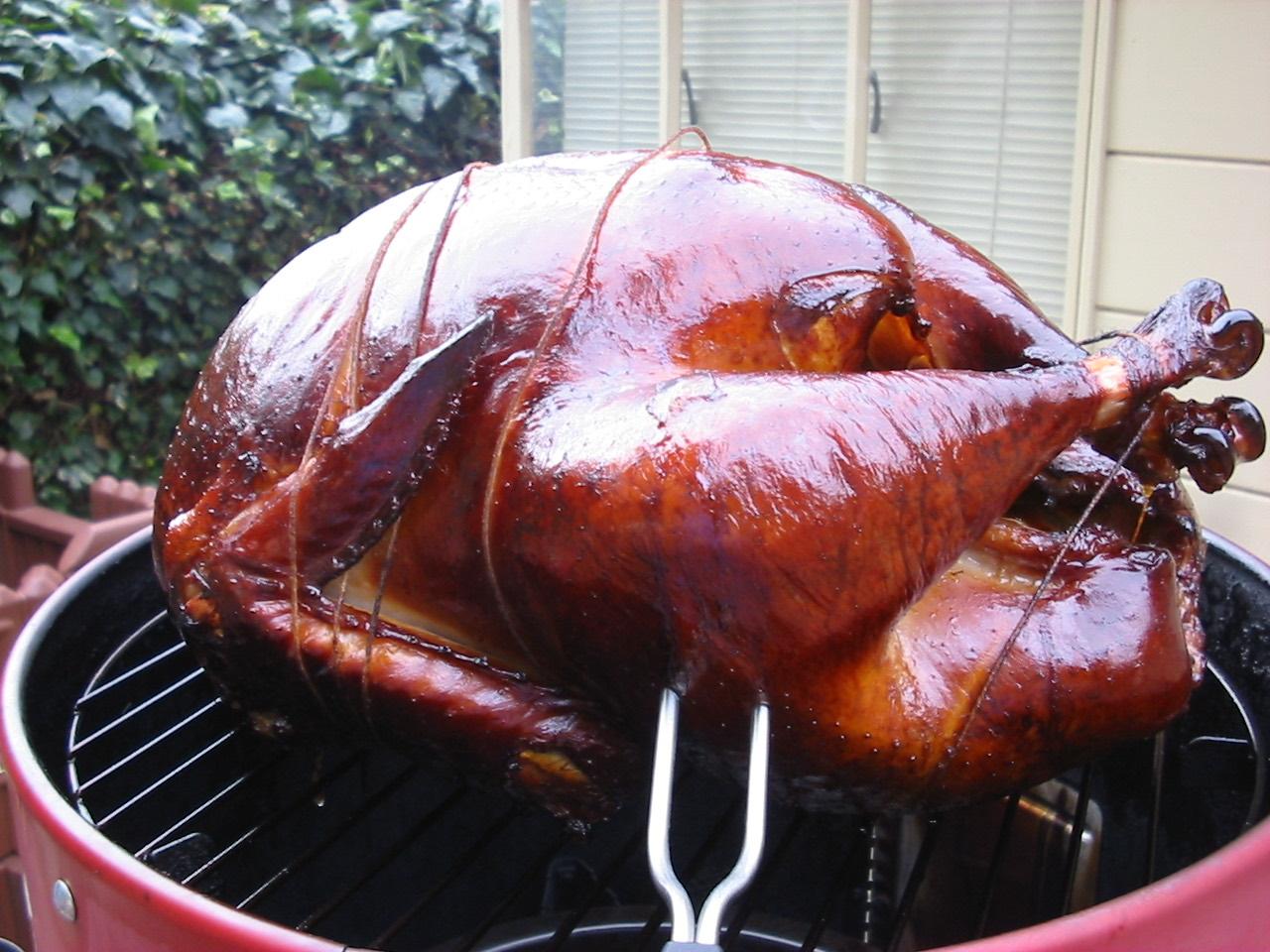
How Long to Smoke a Turkey: Times by Weight and Temperature
Pit Boss charts 25–30 minutes per pound at 250 °F, 20–25 at 275 °F and 15–20 at 300 °F; Traeger gives 30–40 minutes per pound at 225–250 °F. A 14 lb turkey at 250 °F takes about 5 hours 50 minutes to 7 hours. It is done at 165 °F in the thigh, wing and breast (USDA).
Photo: Bill Abbott / Wikimedia Commons (CC BY-SA 2.0)
Turkey Smoking Time Calculator
Enter the weight and your smoker temperature. Times are the published ranges below, multiplied by your weight; the thermometer, not the clock, tells you when it is done.
Estimated smoking time
5 h 50 min to 7 h
14 lb at 250 °F: 25–30 min per lb
Done at 165 °F in the innermost thigh and wing and the thickest part of the breast, then rest 20–30 min.
Your timeline
Pick a meal time to see when to light the smoker.
The plan uses the long end of the range plus the longest rest, so the meat should be ready early rather than late. If it hits temperature early, keep it above 140 °F (out of the USDA danger zone) until you eat, and refrigerate leftovers within 2 hours.
Only the smoker temperatures a named source publishes a time for are offered; we never fill gaps by guessing.
Sources: time per pound from Pit Boss, How to Smoke a Whole Turkey (read 2026-11-16); safe temperatures and the 225–300 °F smoker range from USDA FSIS, Smoking Meat and Poultry.
How long to smoke a turkey comes down to smoker temperature. Pit Boss charts 25–30 minutes per pound at 250 °F, 20–25 at 275 °F and 15–20 at 300 °F; Traeger gives 30–40 minutes per pound at 225–250 °F. Either way the bird is done at 165 °F, the poultry minimum set by the USDA Food Safety and Inspection Service, and a 14 lb turkey at 250 °F works out to 5 hours 50 minutes to 7 hours.
Pick the cut, weight, smoker temperature and serving time in the Turkey Smoking Time Calculator above and it returns the range plus a light-the-smoker time, planned on the long end. Below: what each maker actually publishes, a weight-by-temperature table, why 225 °F is a poor choice for a big bird, where the thermometer goes, spatchcock and breast times, resting, and a worked Thanksgiving timeline.
Gear for this cook
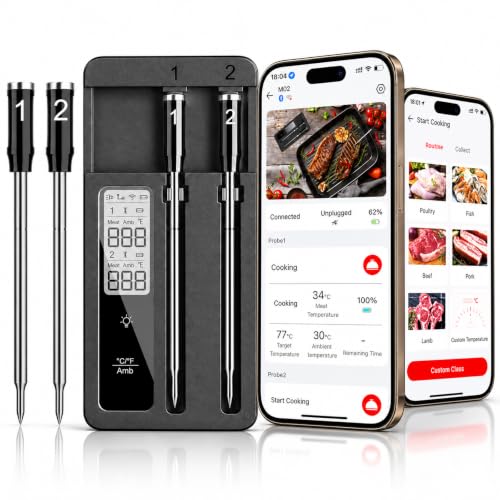
Smart Wireless Meat Thermometer with 2 Probes, 1-Sec Read, ±1°F Accuracy | Digital Meat Thermometer, App Control, 572°F Ceramic Heads, 360FT Wi-Fi Range, IP67 Dishwasher Safe Meat Probes for Grill
$65.99
Check price on Amazon: Smart Wireless Meat Thermometer with 2 Probes, 1-Sec Read, ±1°F Accuracy | Digital Meat Thermometer, App Control, 572°F Ceramic Heads, 360FT Wi-Fi Range, IP67 Dishwasher Safe Meat Probes for Grill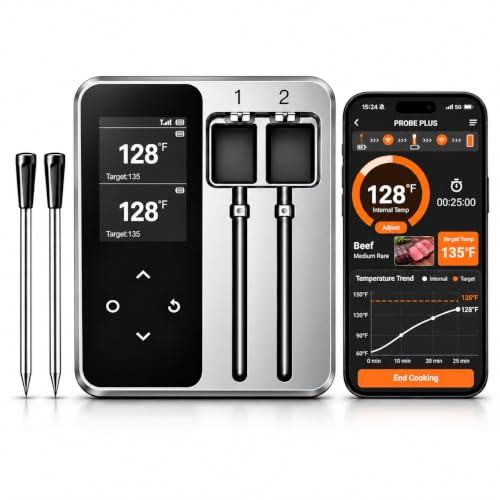
JoyBear Wireless Meat Thermometer, 2 Probes, Smart Base, 6 Sensors | APP Control & Real-Time Alert, Commercial-Grade NIST Certified Accuracy, for Restaurant Kitchen, BBQ/Grill/Oven
$56.99
Check price on Amazon: JoyBear Wireless Meat Thermometer, 2 Probes, Smart Base, 6 Sensors | APP Control & Real-Time Alert, Commercial-Grade NIST Certified Accuracy, for Restaurant Kitchen, BBQ/Grill/Oven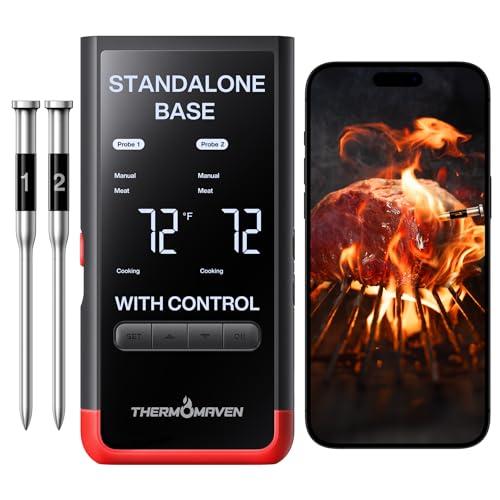
ThermoMaven WiFi Wireless Meat Thermometer, 2 Probes, Smart Base, 6 Sensors | Unlimted Monitor Range via APP, Commercial-Grade NIST Certified Accuracy, for Restaurant Kitchen, BBQ/Grill/Oven
$79.99
Check price on Amazon: ThermoMaven WiFi Wireless Meat Thermometer, 2 Probes, Smart Base, 6 Sensors | Unlimted Monitor Range via APP, Commercial-Grade NIST Certified Accuracy, for Restaurant Kitchen, BBQ/Grill/Oven
ThermoMaven Sub-1G Smart Wireless Meat Thermometer with Standalone Base | 10X Enhanced Signal and Stability, ±0.5℉ Certified Accuracy, WiFi Unlimited Range for BBQ, Oven, Smoker, Grill
$33.99
Check price on Amazon: ThermoMaven Sub-1G Smart Wireless Meat Thermometer with Standalone Base | 10X Enhanced Signal and Stability, ±0.5℉ Certified Accuracy, WiFi Unlimited Range for BBQ, Oven, Smoker, Grill
ThermoMaven Smart WiFi Wireless Meat Thermometer for Grilling with 2 Probes | Standalone Base, 6 Sensors, NIST Certified Accurate to ±0.5℉, 1000ft Wireless Connection, for BBQ/Smoke/Oven
$65.99
Check price on Amazon: ThermoMaven Smart WiFi Wireless Meat Thermometer for Grilling with 2 Probes | Standalone Base, 6 Sensors, NIST Certified Accurate to ±0.5℉, 1000ft Wireless Connection, for BBQ/Smoke/Oven
Smart Bluetooth Wireless Meat Thermometer Digital | 2 Pcs Probe & LCD Screen for Grill,BBQ,Smoker,Air Fryer,Kitchen, Oven,Perfect for Turkey,Steak,Chicken
$34.99
Check price on Amazon: Smart Bluetooth Wireless Meat Thermometer Digital | 2 Pcs Probe & LCD Screen for Grill,BBQ,Smoker,Air Fryer,Kitchen, Oven,Perfect for Turkey,Steak,ChickenSmart Wireless Meat Thermometer with 2 Probes, 1-Sec Read, ±1°F Accuracy | Digital Meat Thermometer, App Control, 572°F Ceramic Heads, 360FT Wi-Fi Range, IP67 Dishwasher Safe Meat Probes for Grill
$65.99
Check price on Amazon: Smart Wireless Meat Thermometer with 2 Probes, 1-Sec Read, ±1°F Accuracy | Digital Meat Thermometer, App Control, 572°F Ceramic Heads, 360FT Wi-Fi Range, IP67 Dishwasher Safe Meat Probes for GrillJoyBear Wireless Meat Thermometer, 2 Probes, Smart Base, 6 Sensors | APP Control & Real-Time Alert, Commercial-Grade NIST Certified Accuracy, for Restaurant Kitchen, BBQ/Grill/Oven
$56.99
Check price on Amazon: JoyBear Wireless Meat Thermometer, 2 Probes, Smart Base, 6 Sensors | APP Control & Real-Time Alert, Commercial-Grade NIST Certified Accuracy, for Restaurant Kitchen, BBQ/Grill/OvenThermoMaven WiFi Wireless Meat Thermometer, 2 Probes, Smart Base, 6 Sensors | Unlimted Monitor Range via APP, Commercial-Grade NIST Certified Accuracy, for Restaurant Kitchen, BBQ/Grill/Oven
$79.99
Check price on Amazon: ThermoMaven WiFi Wireless Meat Thermometer, 2 Probes, Smart Base, 6 Sensors | Unlimted Monitor Range via APP, Commercial-Grade NIST Certified Accuracy, for Restaurant Kitchen, BBQ/Grill/OvenThermoMaven Sub-1G Smart Wireless Meat Thermometer with Standalone Base | 10X Enhanced Signal and Stability, ±0.5℉ Certified Accuracy, WiFi Unlimited Range for BBQ, Oven, Smoker, Grill
$33.99
Check price on Amazon: ThermoMaven Sub-1G Smart Wireless Meat Thermometer with Standalone Base | 10X Enhanced Signal and Stability, ±0.5℉ Certified Accuracy, WiFi Unlimited Range for BBQ, Oven, Smoker, GrillThermoMaven Smart WiFi Wireless Meat Thermometer for Grilling with 2 Probes | Standalone Base, 6 Sensors, NIST Certified Accurate to ±0.5℉, 1000ft Wireless Connection, for BBQ/Smoke/Oven
$65.99
Check price on Amazon: ThermoMaven Smart WiFi Wireless Meat Thermometer for Grilling with 2 Probes | Standalone Base, 6 Sensors, NIST Certified Accurate to ±0.5℉, 1000ft Wireless Connection, for BBQ/Smoke/OvenSmart Bluetooth Wireless Meat Thermometer Digital | 2 Pcs Probe & LCD Screen for Grill,BBQ,Smoker,Air Fryer,Kitchen, Oven,Perfect for Turkey,Steak,Chicken
$34.99
Check price on Amazon: Smart Bluetooth Wireless Meat Thermometer Digital | 2 Pcs Probe & LCD Screen for Grill,BBQ,Smoker,Air Fryer,Kitchen, Oven,Perfect for Turkey,Steak,ChickenPrices and availability are accurate as of November 21, 2026, 2:35 PM UTC and are subject to change.
What every maker says, side by side
Six turkey and smoker brands publish a time for a whole turkey, and no two use the same temperature, unit or weight. Here is each one exactly as printed:
| Maker | Smoker temp | Time stated | Weight it applies to | Done temp stated |
|---|---|---|---|---|
| Pit Boss | 250 / 275 / 300 °F | 25–30 / 20–25 / 15–20 min per lb | Chart columns for 12–14, 14–18 and 18–20 lb | 165 °F breast and thigh |
| Traeger | 225–250 °F | 30–40 min per lb (12 lb ≈ 6 to 8 hours) | 12 lb example | Breast 160 °F, thighs 175 °F |
| Weber | 225–250 / 275–300 °F | 23–27 / 18–21 min per lb | Not stated | 165 °F thigh and breast |
| Masterbuilt | 220 °F | 30 min per lb | 8–12 lb | 165 °F |
| Butterball | 225 °F (electric) / around 250 °F (charcoal water smoker) | 8 to 12 hours / 4–8 hrs (8–12 lb), 6–10 hrs (12–18 lb) | 8 to 18 lb | 170 °F thigh and breast |
| Big Green Egg | 325 °F indirect | 12 min per lb | Not stated | 165 °F |
The spread at the low end is wide. At 225–250 °F, Weber's 23–27 minutes per pound is faster than Traeger's 30–40, and Pit Boss's own answer for a 14 lb bird at 225 °F, "roughly 7–8 hours," lands with Traeger rather than Weber. At 275–300 °F the makers are closer: Weber's single band of 18–21 minutes overlaps both Pit Boss rows, and Masterbuilt's 10–12 lb recipe at 275 °F takes 3.5–4 hours. Because the figures conflict, the calculator uses one named source per temperature (Traeger at 225 °F, Pit Boss at 250, 275 and 300 °F) and never blends them.
Turkey smoking times by weight and temperature
This table multiplies each weight by the per-pound rate the calculator uses. It is the same arithmetic the tool runs, so the two always agree.
| Weight | 225 °F (Traeger) | 250 °F (Pit Boss) | 275 °F (Pit Boss) | 300 °F (Pit Boss) |
|---|---|---|---|---|
| 12 lb | 6 h to 8 h | 5 h to 6 h | 4 h to 5 h | 3 h to 4 h |
| 14 lb | 7 h to 9 h 20 min | 5 h 50 min to 7 h | 4 h 40 min to 5 h 50 min | 3 h 30 min to 4 h 40 min |
| 16 lb | 8 h to 10 h 40 min | 6 h 40 min to 8 h | 5 h 20 min to 6 h 40 min | 4 h to 5 h 20 min |
| 18 lb | 9 h to 12 h | 7 h 30 min to 9 h | 6 h to 7 h 30 min | 4 h 30 min to 6 h |
| 20 lb | 10 h to 13 h 20 min | 8 h 20 min to 10 h | 6 h 40 min to 8 h 20 min | 5 h to 6 h 40 min |
Pit Boss also prints whole-bird ranges beside its per-pound figures, and they are a little wider than the multiplication: 12–14 lb takes 5–7 hrs at 250 °F, 4–6 hrs at 275 °F and 3–4.5 hrs at 300 °F; 18–20 lb takes 7.5–10 hrs, 6–8.5 hrs and 4.5–6.5 hrs. Pit Boss calls all of these "estimates only" and says actual time depends on the bird, the weather and the grill. Weber adds about 3 minutes per pound when it is cold, and Traeger adds 10–15 minutes per pound above 5,000 feet.
Every figure stops at 20 lb. No maker in this comparison publishes a smoker time for a heavier turkey, and Butterball's smoker instructions are written for an 8 to 18 lb bird.
Why 225 °F is risky for a big bird
USDA says to keep a smoker between 225 and 300 °F for the whole cook, so 225 °F is the floor of the safe range, not a target with room below it. The concern at the low end is time in the Danger Zone, 40 to 140 °F, and two makers put a clock on it:
- Butterball: the turkey must pass through 40 °F to 140 °F in 4 hours or less. Check it after 3½ hours; if the internal temperature is low, take it off the smoker and finish it in the oven.
- Pit Boss: do not let the turkey sit below 140 °F for more than 3 hours.
The two rules differ by an hour, and the stricter one is Pit Boss's. A large, cold bird at 225 °F is the case most likely to fail either test, because the heat has the most mass to get through at the lowest air temperature.
Pit Boss's answer is a two-stage cook: smoke 2 to 3 hours at a lower temperature, then increase the heat to finish to 165 °F. Traeger describes the same idea from 225 °F: smoke for a few hours, then raise the grill to around 350 °F to finish. Both keep the smoke flavor of a low start and cut the time the meat spends cool. Traeger also suggests going to 275 °F toward the end of the cook to crisp the skin.
Two USDA rules make 225 °F safer when you do use it: the bird must be completely thawed before it goes on (the how long to thaw a turkey page has the USDA table and Thanksgiving start dates), and it should not be stuffed. Butterball says "Do not stuff your turkey" for the smoker, and Traeger does not recommend stuffing the cavity.
Where the thermometer goes, and which pull temperature to trust
USDA's rule is 165 °F for all poultry, measured in the innermost part of the thigh and wing and the thickest part of the breast (Let's Talk Turkey; the Safe Minimum Internal Temperature Chart lists 165 °F for whole birds, breasts, legs, thighs and wings). USDA says you need two thermometers when smoking: one in the meat and one for the smoker's air temperature.
The makers agree on placement but not on the number:
- Pit Boss and Weber: 165 °F in the thickest part of the breast and the innermost part of the thigh. Pit Boss says to check both because they don't always finish at the same time.
- Butterball: 170 °F in the thigh and 170 °F in the breast.
- Traeger: pull when the breast reads 160 °F, because it rises 5–10 °F while resting, and wait until the thighs reach 175 °F.
Treat USDA's 165 °F as the safety floor at every probe point. Butterball's 170 °F is above it. Traeger's 160 °F breast pull relies on carryover during the rest to reach 165 °F; if you use it, confirm the breast has reached 165 °F before carving. Higher thigh temperatures are a texture preference, and USDA notes consumers may choose to cook turkey to higher temperatures.
Spatchcock turkey: the fastest smoke
Splitting out the backbone and flattening the bird changes the math. Weber's smoked spatchcocked turkey runs at 225–275 °F for approximately 11–13 minutes a pound, then rests approximately 30 minutes once the breast reaches 165 °F. An illustrative 14 lb spatchcocked bird at that rate takes 2 hours 34 minutes to 3 hours 2 minutes, roughly half of a whole bird at 250 °F, which matches Camp Chef's note that a spatchcocked turkey cooks in "almost half the time."
Traeger's spatchcock methods are multi-stage rather than per pound: its spatchcock guide smokes at 225 °F to 160 °F in about 3–4 hours, then 375 °F for 20–30 minutes to 165 °F; a recipe on its site smokes an 18 to 20 lb bird at 225 °F for about 2 to 2.5 hours, then finishes at 375 °F for about 1 to 1.5 hours.
Smoking a turkey breast
The only breast figure published at a true smoking temperature is Masterbuilt's: a 6 to 7 lb breast at 225 °F for 4½ to 5 hours, about 45 minutes per pound, to 165 °F. At that rate an illustrative 6.5 lb breast needs about 4 hours 53 minutes. Plan on the high end: Masterbuilt's recipe header lists a cook time of 5 to 6 hours.
Traeger's brined breast is a hotter cook, 375 °F for 2–2½ hours for an 8–10 lb breast, and the recipe tips say to pull at 160 °F and let carryover take it to 165 °F. No maker reviewed here publishes a breast time at 250, 275 or 300 °F, so at those temperatures go by the thermometer. A breast is also the easiest way to feed a small group; the turkey per person page has the USDA serving rules.
Resting: 20 minutes, or 30% of the cook?
Every source says to rest, and they give five different lengths:
| Source | Rest stated | For a 14 lb bird at 250 °F (5 h 50 min to 7 h) |
|---|---|---|
| USDA FSIS | Stand 20 minutes before carving | 20 min |
| Pit Boss | 20–30 minutes | 20–30 min |
| Weber | 20–30% of the total cooking time | 70 min to 2 h 6 min |
| Traeger | 15 to 20 minutes (guide) | 15–20 min |
| Butterball | 15 minutes (water smoker); 20 minutes (electric) | 15–20 min |
| Camp Chef | At least 20 minutes; up to three hours in a large cooler | 20 min to 3 h |
USDA's 20 minutes is a quality step ("to allow juices to set"). Camp Chef's cooler hold is how an early turkey waits for late guests. The calculator plans on Pit Boss's 30 minutes, the long end of its range, so the bird is ready slightly early rather than late. After the meal, USDA says to refrigerate smoked meat and poultry within 2 hours of removing it from the smoker.
Worked timeline: a 14 lb turkey at 250 °F for a 4 pm Thanksgiving dinner
This is an illustrative plan for Thursday, November 26, 2026, computed the way the calculator does it: Pit Boss's 25–30 minutes per pound at 250 °F, planned on the long end (14 × 30 = 7 hours), plus the 30-minute long end of Pit Boss's rest and a 30-minute preheat.
- Sunday, November 22, morning: move the frozen bird to the fridge (USDA: 3 to 4 days for 12 to 16 lb).
- 8:00 am Thursday: light the smoker and bring it to 250 °F.
- 8:30 am: turkey on, probe in the thickest part of the breast.
- 2:20 pm: start checking. This is the short end of the range (14 × 25 = 5 hours 50 minutes), and the turkey may already be at 165 °F.
- 3:30 pm at the latest: off the smoker once breast and thigh read 165 °F, tented and resting.
- 4:00 pm: carve and serve.
Against the Danger Zone rules above, check the internal temperature by 11:30 am (Pit Boss's 3 hours) and no later than noon (Butterball's 3½-hour check). If it is still under 140 °F, raise the heat or move to the oven. For other cuts on the same day, the smoking time calculator covers ribs, pork butt and chicken, and the chicken smoking times page is useful if you add a second, smaller bird.
Running late or running early
Running late. The thermometer, not the clock, decides; Pit Boss says to use its chart as a starting point and let the thermometer tell you when it's done. Your options, from the sources:
- Raise the smoker temperature, staying within USDA's 225–300 °F smoker range. Moving from 250 to 300 °F drops Pit Boss's rate from 25–30 to 15–20 minutes per pound.
- Follow Butterball's rule: if the internal temperature is low after 3½ hours, take the turkey off the smoker and finish it in the oven.
- Use Traeger's finish: after a few hours of smoke, crank the heat to around 350 °F.
Pit Boss recommends leaving a probe in the breast for the whole cook so you can track it without opening the grill to check by hand. Weber suggests checking the temperature halfway, three quarters of the way, and when you think it is done.
Running early. Keep the cooked bird out of the 40–140 °F Danger Zone. Camp Chef's method is to hold it in a large cooler for up to three hours. If it will not be eaten within 2 hours of leaving the smoker, USDA says to cut it into smaller portions, place it in shallow containers and refrigerate it.
A smoker that holds temperature steadily makes all of this easier to predict; the outdoor kitchen smoker page covers where one fits in a backyard build, and the Outdoor Kitchen Setup home page has the full turkey planner.
Frequently Asked Questions
01How long to smoke a turkey at 250 °F?
02How long to smoke a turkey at 275 °F?
03How long to smoke a turkey at 225 °F?
04How many minutes per pound to smoke a turkey?
05How long to smoke a 20 lb turkey?
06How long to smoke a turkey at 300 °F?
07Can you smoke a frozen turkey?
08How long should a smoked turkey rest?
This guide is part of Smoke Times: Calculator and Chart for Every Cut — the hub covering every smoking & bbq guide on Outdoor Kitchen Setup.
Related Guides
Written and edited by Sukie
Sukie is the editor behind Outdoor Kitchen Setup. They compile manufacturer specification sheets, published building codes, and industry sizing standards into the measurement and planning guides on this site, and USDA food-safety guidance and smoker makers’ published times into its smoking and turkey calculators. They check every figure against its original source before it goes live. Where a number varies by brand or by local code, the guides say so rather than presenting a single figure as universal.