Outdoor Turkey Fryer: Where to Set It Up, How Much Oil, and When Not to Use One
Read this before you light an outdoor turkey fryer: the National Fire Protection Association strongly discourages the use of turkey fryers .
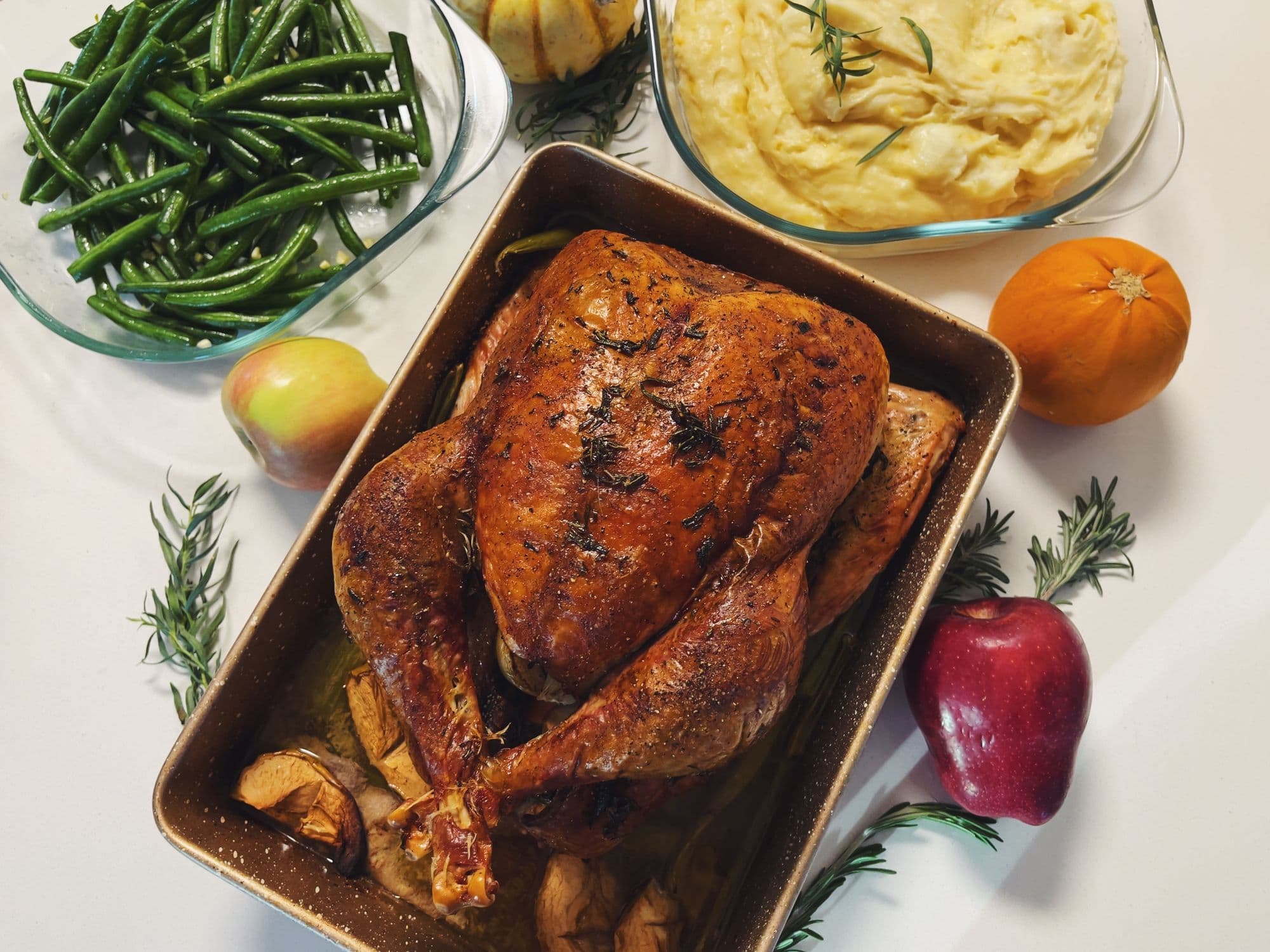
Photo: Rufina Rusakova / Pexels (Pexels License)
Read this before you light an outdoor turkey fryer: the National Fire Protection Association strongly discourages the use of turkey fryers. Its Thanksgiving safety page says fryers that use cooking oil “are not safe” because they use large amounts of oil at high temperatures, and suggests buying a fried turkey from a grocery store or restaurant, or buying a fryer that does not use oil.
That is the honest starting point. Plenty of people fry anyway, and two federal agencies publish instructions for doing it: the Consumer Product Safety Commission and the USDA Food Safety and Inspection Service. This page puts their guidance side by side, in the order you will need it on the day, and shows where they disagree. Nothing here makes oil frying safe. It makes it less likely to go wrong.
Top picks for this build
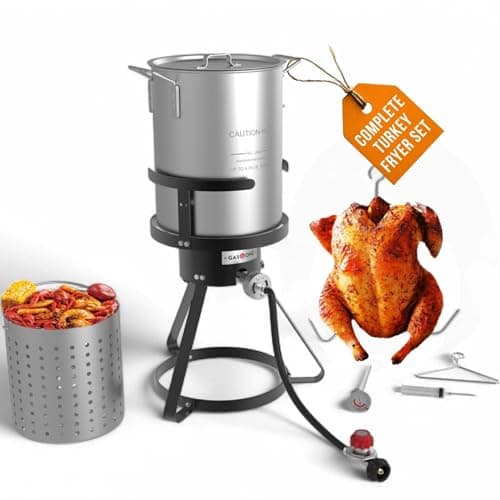
GasOne 30QT Turkey Fryer Set and Seafood Boil with Propane Gas Burner, Perforated Basket – Perfect Outdoor Cooker for Crawfish, Crab, Shrimp, Lobster, and Frying – Complete Outdoor Cooking Kit
$69.99
Check price on Amazon: GasOne 30QT Turkey Fryer Set and Seafood Boil with Propane Gas Burner, Perforated Basket – Perfect Outdoor Cooker for Crawfish, Crab, Shrimp, Lobster, and Frying – Complete Outdoor Cooking Kit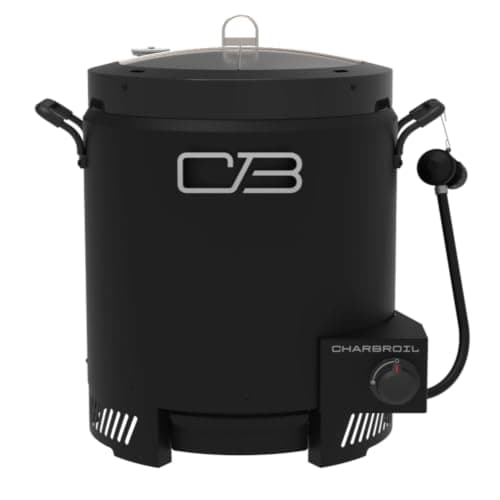
Charbroil The Big Easy Oil-Less Turkey Fryer | Outdoor Air Fryer | Propane Cooker, Black - 24102165
$149.97
Check price on Amazon: Charbroil The Big Easy Oil-Less Turkey Fryer | Outdoor Air Fryer | Propane Cooker, Black - 24102165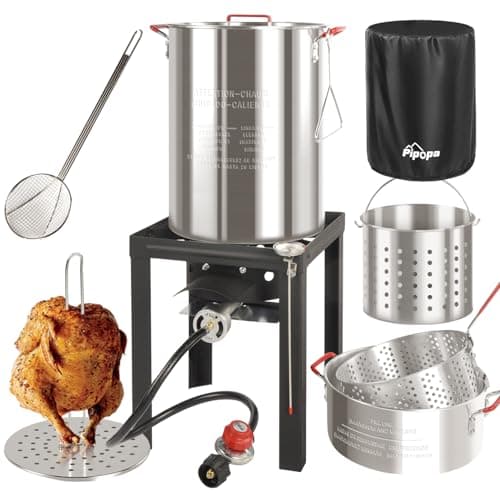
30QT & 10QT Outdoor Fryer | Turkey Fryer | Seafood Boil Pot | Cover & Skimmer Included | 50,000BTU Propane Burner | Aluminum Deep Fryer Pot with Basket | Crab, Seafood & Crawfish Boiler
$89.99
Check price on Amazon: 30QT & 10QT Outdoor Fryer | Turkey Fryer | Seafood Boil Pot | Cover & Skimmer Included | 50,000BTU Propane Burner | Aluminum Deep Fryer Pot with Basket | Crab, Seafood & Crawfish Boiler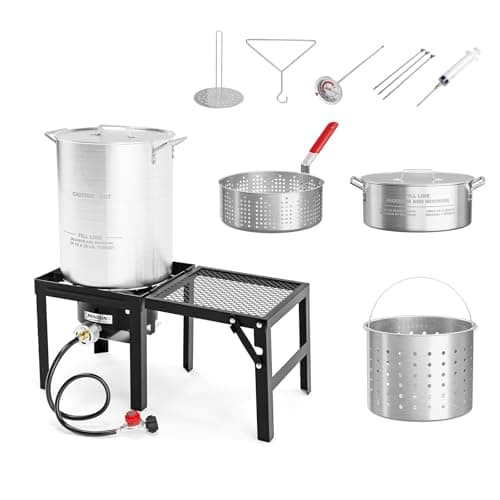
ROVSUN 30QT Turkey Fryer & 10QT Fish Fryer Kit w/ 55,000BTU Propane Stove, Aluminum Outdoor Deep Fryer & Seafood Boiler Steamer w/Baskets, Thermometer, Marinade Injector, Turkey Rack & Rack Lifter
$109.99
Check price on Amazon: ROVSUN 30QT Turkey Fryer & 10QT Fish Fryer Kit w/ 55,000BTU Propane Stove, Aluminum Outdoor Deep Fryer & Seafood Boiler Steamer w/Baskets, Thermometer, Marinade Injector, Turkey Rack & Rack Lifter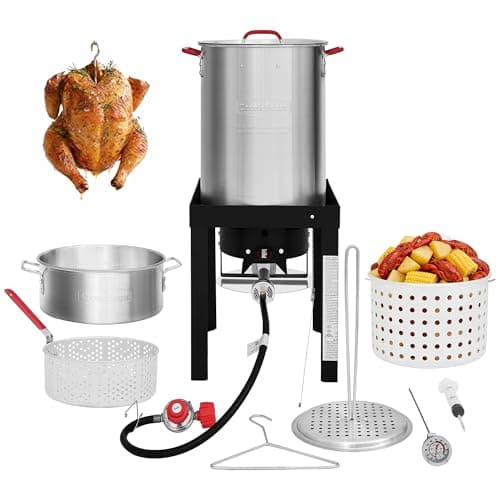
CreoleFeast TFS3010 Turkey Fryer & Seafood Boil 30/10QT Aluminum 50,000BTU | Propane Outdoor Deep Fryer, Thermometer & Injector Included, Versatile All-Welded Stand, Great for Backyard Parties & Camping
$107.99
Check price on Amazon: CreoleFeast TFS3010 Turkey Fryer & Seafood Boil 30/10QT Aluminum 50,000BTU | Propane Outdoor Deep Fryer, Thermometer & Injector Included, Versatile All-Welded Stand, Great for Backyard Parties & Camping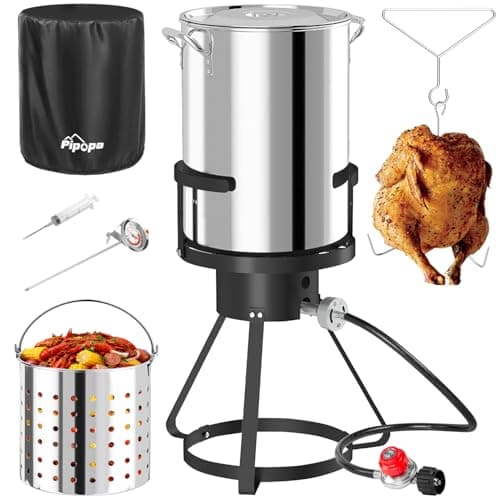
30QT Stainless Steel Turkey Fryer | Outdoor Fryers with Cover | Basket | 50,000 BTU Propane Burner | Ideal for Crawfish Shrimp Lobster Seafood Boiling & Turkey Frying
$74.99
Check price on Amazon: 30QT Stainless Steel Turkey Fryer | Outdoor Fryers with Cover | Basket | 50,000 BTU Propane Burner | Ideal for Crawfish Shrimp Lobster Seafood Boiling & Turkey Frying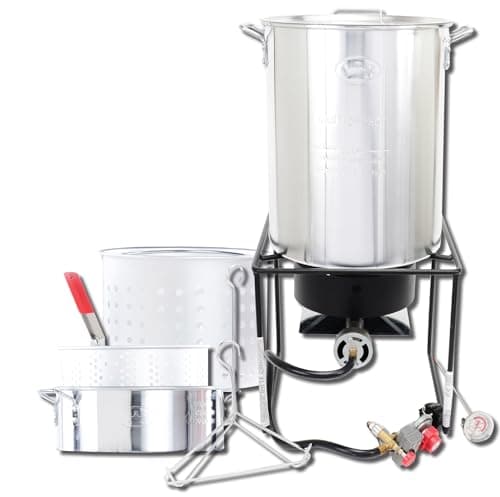
King Kooker Propane Outdoor Fry Boil Package with 2 Pots, silver, one size (12RTFBF3)
$119.47
Check price on Amazon: King Kooker Propane Outdoor Fry Boil Package with 2 Pots, silver, one size (12RTFBF3)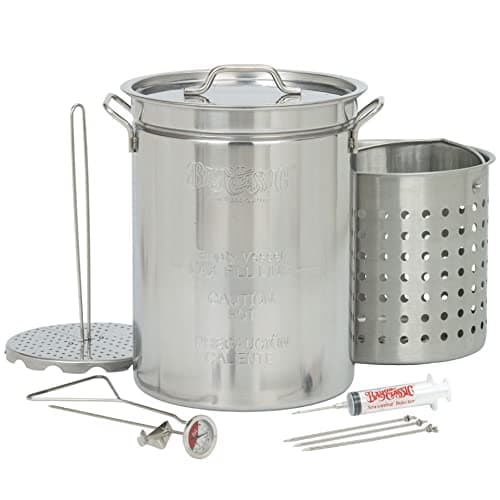
Bayou Classic 1118 32-qt Stainless Turkey Fryer Features Vented Lid Perforated Poultry Rack 12-in Stainless Fry Thermometer 2-oz Seasoning Injector
$142.88
Check price on Amazon: Bayou Classic 1118 32-qt Stainless Turkey Fryer Features Vented Lid Perforated Poultry Rack 12-in Stainless Fry Thermometer 2-oz Seasoning InjectorGasOne 30QT Turkey Fryer Set and Seafood Boil with Propane Gas Burner, Perforated Basket – Perfect Outdoor Cooker for Crawfish, Crab, Shrimp, Lobster, and Frying – Complete Outdoor Cooking Kit
$69.99
Check price on Amazon: GasOne 30QT Turkey Fryer Set and Seafood Boil with Propane Gas Burner, Perforated Basket – Perfect Outdoor Cooker for Crawfish, Crab, Shrimp, Lobster, and Frying – Complete Outdoor Cooking KitCharbroil The Big Easy Oil-Less Turkey Fryer | Outdoor Air Fryer | Propane Cooker, Black - 24102165
$149.97
Check price on Amazon: Charbroil The Big Easy Oil-Less Turkey Fryer | Outdoor Air Fryer | Propane Cooker, Black - 2410216530QT & 10QT Outdoor Fryer | Turkey Fryer | Seafood Boil Pot | Cover & Skimmer Included | 50,000BTU Propane Burner | Aluminum Deep Fryer Pot with Basket | Crab, Seafood & Crawfish Boiler
$89.99
Check price on Amazon: 30QT & 10QT Outdoor Fryer | Turkey Fryer | Seafood Boil Pot | Cover & Skimmer Included | 50,000BTU Propane Burner | Aluminum Deep Fryer Pot with Basket | Crab, Seafood & Crawfish BoilerROVSUN 30QT Turkey Fryer & 10QT Fish Fryer Kit w/ 55,000BTU Propane Stove, Aluminum Outdoor Deep Fryer & Seafood Boiler Steamer w/Baskets, Thermometer, Marinade Injector, Turkey Rack & Rack Lifter
$109.99
Check price on Amazon: ROVSUN 30QT Turkey Fryer & 10QT Fish Fryer Kit w/ 55,000BTU Propane Stove, Aluminum Outdoor Deep Fryer & Seafood Boiler Steamer w/Baskets, Thermometer, Marinade Injector, Turkey Rack & Rack LifterCreoleFeast TFS3010 Turkey Fryer & Seafood Boil 30/10QT Aluminum 50,000BTU | Propane Outdoor Deep Fryer, Thermometer & Injector Included, Versatile All-Welded Stand, Great for Backyard Parties & Camping
$107.99
Check price on Amazon: CreoleFeast TFS3010 Turkey Fryer & Seafood Boil 30/10QT Aluminum 50,000BTU | Propane Outdoor Deep Fryer, Thermometer & Injector Included, Versatile All-Welded Stand, Great for Backyard Parties & Camping30QT Stainless Steel Turkey Fryer | Outdoor Fryers with Cover | Basket | 50,000 BTU Propane Burner | Ideal for Crawfish Shrimp Lobster Seafood Boiling & Turkey Frying
$74.99
Check price on Amazon: 30QT Stainless Steel Turkey Fryer | Outdoor Fryers with Cover | Basket | 50,000 BTU Propane Burner | Ideal for Crawfish Shrimp Lobster Seafood Boiling & Turkey FryingKing Kooker Propane Outdoor Fry Boil Package with 2 Pots, silver, one size (12RTFBF3)
$119.47
Check price on Amazon: King Kooker Propane Outdoor Fry Boil Package with 2 Pots, silver, one size (12RTFBF3)Bayou Classic 1118 32-qt Stainless Turkey Fryer Features Vented Lid Perforated Poultry Rack 12-in Stainless Fry Thermometer 2-oz Seasoning Injector
$142.88
Check price on Amazon: Bayou Classic 1118 32-qt Stainless Turkey Fryer Features Vented Lid Perforated Poultry Rack 12-in Stainless Fry Thermometer 2-oz Seasoning InjectorPrices and availability are accurate as of October 22, 2026, 11:45 AM UTC and are subject to change.
What NFPA, CPSC and USDA Actually Say About Turkey Fryers
The three agencies agree on the dangers and differ on whether you should fry at all. Compiled from each agency’s own page, read October 16, 2026:
| Question | NFPA | CPSC | USDA FSIS |
|---|---|---|---|
| Should you use an oil turkey fryer? | No. “NFPA strongly discourages the use of turkey fryers.” | Gives safety tips for consumers “who choose to fry turkeys” | Describes deep frying as an alternate route, noting “there are safety concerns when working with such a large amount of oil” |
| Where? | — | Open area away from walls, fences or other structures; never in, on or under a garage, breezeway, carport or porch; off the deck and away from the house | “A safe location outdoors” |
| Turkey size | — | — | 12 pounds or less, not stuffed, completely thawed |
| How much oil? | — | Follow the manufacturer; otherwise a water test with about ½ in of water over the bird | Water test; oil should cover the turkey by 1 to 2 in |
| Oil temperature | — | Check it frequently; turn off the gas if it smokes | 350°F (turkey page) or 375°F (deep-frying page) |
| Cooking time | — | — | About 3 to 5 minutes per pound |
| Done when | — | — | 165°F in the innermost thigh and wing and thickest part of the breast |
| Grease fire | — | Call 911; do not use water | Extinguisher or a metal lid; never water; call 911 |
Sources: NFPA Thanksgiving safety page; CPSC release 04-041 (dated November 26, 2003) and release 26-093 (November 19, 2025); USDA FSIS Turkey: Alternate Routes to the Table (updated February 19, 2026) and Deep Fat Frying and Food Safety (updated August 9, 2024).
The backdrop is Thanksgiving itself. NFPA reports that it is the peak day for home cooking fires, with more than three times the daily average, and estimates 1,139 home cooking fires on Thanksgiving Day 2024. CPSC’s 2025 release gives its own figure: an average of 1,400 cooking fires on Thanksgiving Day.
Pick the Spot Before You Buy the Bird
Placement is the one decision you cannot fix once the oil is hot. CPSC’s 2003 guidance and its 2025 “COOK” reminder add up to this checklist:
- An open area away from all walls, fences and other structures.
- Never in, on or under a garage, breezeway, carport, porch, or any structure that can catch fire.
- Off the deck and away from the house (the K in CPSC’s COOK).
- At least 2 feet between the propane tank and the fryer burner.
- Tank and fryer arranged so any wind blows the burner’s heat away from the tank.
- The pot centered over the burner.
CPSC asks for the pot to be centered over the burner; a level, non-combustible surface helps keep it there. Choose a spot away from where people walk, too. If your patio is built on joists, our page on an outdoor kitchen on a deck explains why decks need extra care with any open flame; for a fryer, CPSC’s answer is simply not to use one there.
Before you buy an outdoor turkey fryer kit
Shop with the agencies’ steps in mind rather than the burner rating on the box:
- Pot size: FSIS says to select a vessel large enough to completely submerge the turkey in oil without it spilling over. Do the water test below with your actual bird before the day, and return the kit if the pot cannot pass it.
- Thermometer: CPSC says to check the oil temperature frequently and FSIS says to monitor it constantly. If the kit has no frying thermometer, buy one.
- Lifting hook and rack or basket: both agencies say to lower and raise the bird slowly. A hook that keeps your hand well above the pot makes that possible.
- Manual with a fill line and burner instructions: CPSC’s first COOK rule is to carefully follow the manufacturer’s instructions, so you need a manual that has them.
If you are still working out where outdoor cooking happens at your place, our outdoor cooking setup guide covers zones and distances for every kind of cooker.
Can You Use an Outdoor Turkey Fryer in Your Outdoor Kitchen?
Usually not inside it. CPSC says never to use a fryer under a carport, porch or any structure that can catch fire, so a pergola, roof or covered outdoor kitchen is out. So is a built-in island that sits against the house wall. What an outdoor kitchen is good for is everything around the fryer: a sink for washing up, counter space for the tray, the thermometer and the paper towels, and a gas line you are not using for the fryer. Set the fryer on open, level ground a safe distance away and carry the finished bird to the counter.
Thaw It All the Way, Then Dry It
Ice and water are what make hot oil boil over. CPSC says partially frozen or wet turkeys “can produce excessive hot oil splatter,” and USDA says a fried turkey must be completely thawed. FSIS’s thawing page gives the times: about 24 hours for every 4 to 5 pounds in a refrigerator at 40°F or below, or about 30 minutes per pound in cold water changed every 30 minutes.
Worked for a 12-pound turkey, the largest USDA recommends frying, with Thanksgiving on Thursday, November 26, 2026:
| Method | Arithmetic | Time needed | Start by |
|---|---|---|---|
| Refrigerator | 12 ÷ 5 × 24 h to 12 ÷ 4 × 24 h | 57.6 to 72 hours (FSIS table: 1 to 3 days for 4–12 lb) | Monday, November 23, morning, for a Thursday fry |
| Cold water | 12 × 30 min | 6 hours (FSIS table: 2 to 6 hours for 4–12 lb) | Early Thursday; cook immediately after |
FSIS says a refrigerator-thawed turkey can stay in the fridge 1 or 2 more days before cooking, so starting Sunday the 22nd gives you a margin. A cold-water-thawed bird must be cooked right away. Never thaw on the counter: FSIS says a package left out more than 2 hours is not at a safe temperature, even if the center is still frozen.
Then dry it. Pat the bird dry inside and out with paper towels; CPSC says to dry it as well as thaw it. Do not stuff it; USDA’s method requires an unstuffed turkey.
The Water Test: How Much Oil Your Pot Needs
Overfilling is the second O in CPSC’s COOK. Use the fryer manufacturer’s fill line if it has one. If not, both agencies describe the same water test, done the day before with a cold, empty pot:
- Put the thawed turkey in the empty pot (in its basket or rack if the fryer has one).
- Add water until the turkey is covered. CPSC says by about ½ inch; FSIS says the oil should end up covering the turkey by 1 to 2 inches.
- Lift the turkey out and let it drain back into the pot.
- Mark the water level on the pot, or pour the water into jugs and measure it. That is the amount of oil to buy.
- Dump the water and dry the pot and turkey completely. Any water left in the pot will spatter violently in hot oil.
To turn the measurement into a shopping list, 4 quarts make a gallon. If your water filled three 1-gallon jugs, you need 3 gallons of oil, and anything beyond your marked line is overfill.
For the oil itself, FSIS lists approximate smoke points of 450°F for peanut, safflower and soybean oil, 445°F for grapeseed, 435°F for canola, and 410°F for corn, olive, sesame and sunflower. CPSC’s COOK says to use an oil with a high smoke point and never overheat it.
Frying, Step by Step
CPSC’s 2003 release notes that the majority of reported fryer incidents happened while the oil was being heated, before the turkey went in. Watching the thermometer during warm-up matters as much as anything that follows.
- Gear up. Have a fire extinguisher nearby (FSIS), a long-stem frying thermometer, a food thermometer, heavy gloves, and clothing that covers bare skin (CPSC).
- Heat the oil and stay with it. Keep the fryer in full view while the burner is on. FSIS’s turkey page says to heat the oil to 350°F; its general deep-frying table lists 375°F for turkey. Pick your target from the fryer manual if it gives one. If the oil smokes at all, turn the gas off immediately.
- Lower slowly. CPSC says to raise and lower food slowly to reduce splatter, and FSIS says to lower the turkey “slowly and carefully.” Follow your fryer manual for what to do with the burner while you lower it.
- Time it. FSIS: about 3 to 5 minutes per pound. For a 12-pound turkey that is 36 to 60 minutes. Monitor the oil temperature constantly and never leave it.
- Lift, drain, probe. Take the turkey out of the oil before checking it; FSIS says a reading taken while the food is submerged is inaccurate. It is done at 165°F in the innermost part of the thigh and wing and the thickest part of the breast. If not, return it to the oil.
- Rest. Set it on a sturdy tray lined with paper towels and let it rest about 20 minutes before carving. FSIS notes the skin can be golden to dark brown to almost black.
- Shut down. Turn off the burner and the propane cylinder valve, and leave the pot where it is.
If the Oil Catches Fire
- Call 911 immediately, as both CPSC and FSIS say.
- Never use water. FSIS explains that water meeting oil at about 350°F turns instantly into superheated steam, and using water on a grease fire can make flaming oil splatter and spread.
- FSIS names a fire extinguisher or covering the fryer with a metal lid as the best way to put out a grease fire.
Oil-Less Fryers and Other Ways to Get a Crisp Bird
NFPA’s own suggestion is a fryer that does not use oil. The best-known outdoor version is Char-Broil’s Big Easy. Its product page says it needs no oil, handles “a 16-pound turkey or chicken, an 8-pound roast, or a 6-pound pork shoulder,” and lights with an integrated piezo ignition; the product photos list a 16,000 BTU propane burner, tank not included.
It removes the gallons of hot oil, which is the hazard NFPA and CPSC describe. It is still a propane burner with a hot surface, so follow its manual for where to set it, and still cook the bird to 165°F. Its 16-pound rating is also above USDA’s 12-pound guidance for oil frying.
Other routes: FSIS’s Alternate Routes page describes grilling a whole turkey by indirect heat over a drip pan in a covered gas or charcoal grill, and a smoker is another option. Our outdoor kitchen smoker page covers built-in smokers, and outdoor kitchen cooking equipment compares grills, griddles, smokers and pizza ovens.
Cooling, Storing and Getting Rid of the Oil
Hot oil stays hot long after dinner. FSIS says to let a fryer cool completely, approximately 2 hours, before you handle or clean it. Then:
- To reuse it: strain it through cheesecloth or a sieve. FSIS’s turkey page says strained, covered oil can be reused within a month; its deep-frying page says up to 3 months in a sealed, light-proof container, refrigerated for best quality. Discard it if it is cloudy, foams or smells off.
- To throw it out: pour it into a sealable container and put that in the trash, or take it to a recycling point that accepts cooking oil.
- Never pour it down the sink. FSIS warns it congeals in drains and septic or sewer systems.
- Leftovers: refrigerate within 2 hours of frying, or 1 hour if it is above 90°F.
If you are deciding what cooking gear belongs in a permanent setup, see outdoor kitchen appliances, or start from the Outdoor Kitchen Setup homepage.
Frequently Asked Questions
01Is an outdoor turkey fryer safe?
02How much oil does a turkey fryer need?
03What temperature should the oil be for frying a turkey?
04How long does it take to deep fry a turkey?
05Can I use a turkey fryer on a wooden deck or in the garage?
06What size turkey can you fry?
This guide is part of Outdoor Kitchen Cooking Equipment: Grills, Griddles, Smokers, and Pizza Ovens — the hub covering every grills & cooking guide on Outdoor Kitchen Setup.
Related Guides
Written and edited by Sukie
Sukie is the editor behind Outdoor Kitchen Setup. They compile manufacturer specification sheets, published building codes, and industry sizing standards into the measurement and planning guides on this site, and check every figure against its original source before it goes live. Where a number varies by brand or by local code, the guides say so rather than presenting a single figure as universal.