Outdoor Kitchen Pizza Oven Dimensions: Counter Height, Footprint, and Clearance
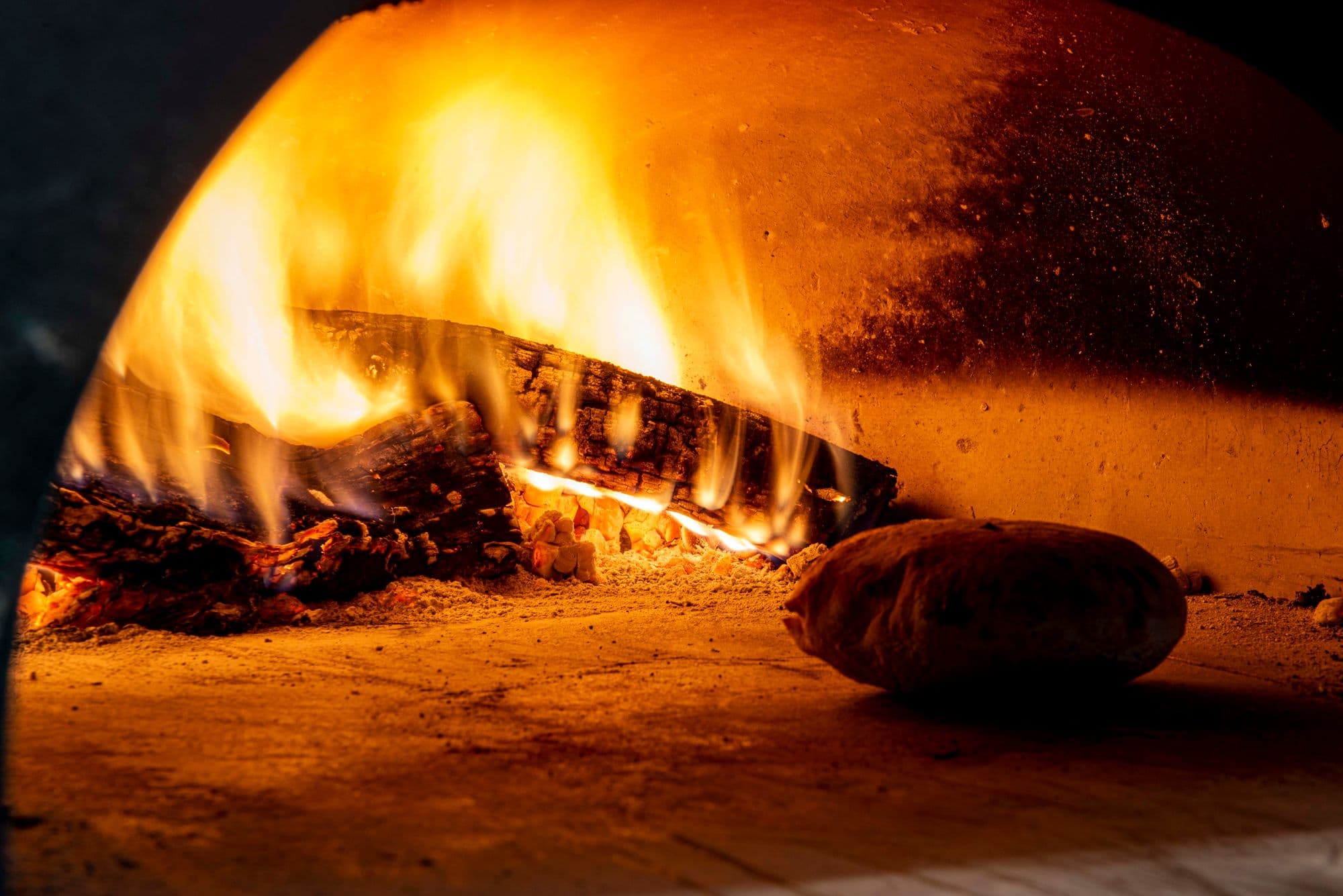
Outdoor kitchen pizza oven dimensions are governed by one measurement most planning guides never mention: the height of the oven mouth off the ground.
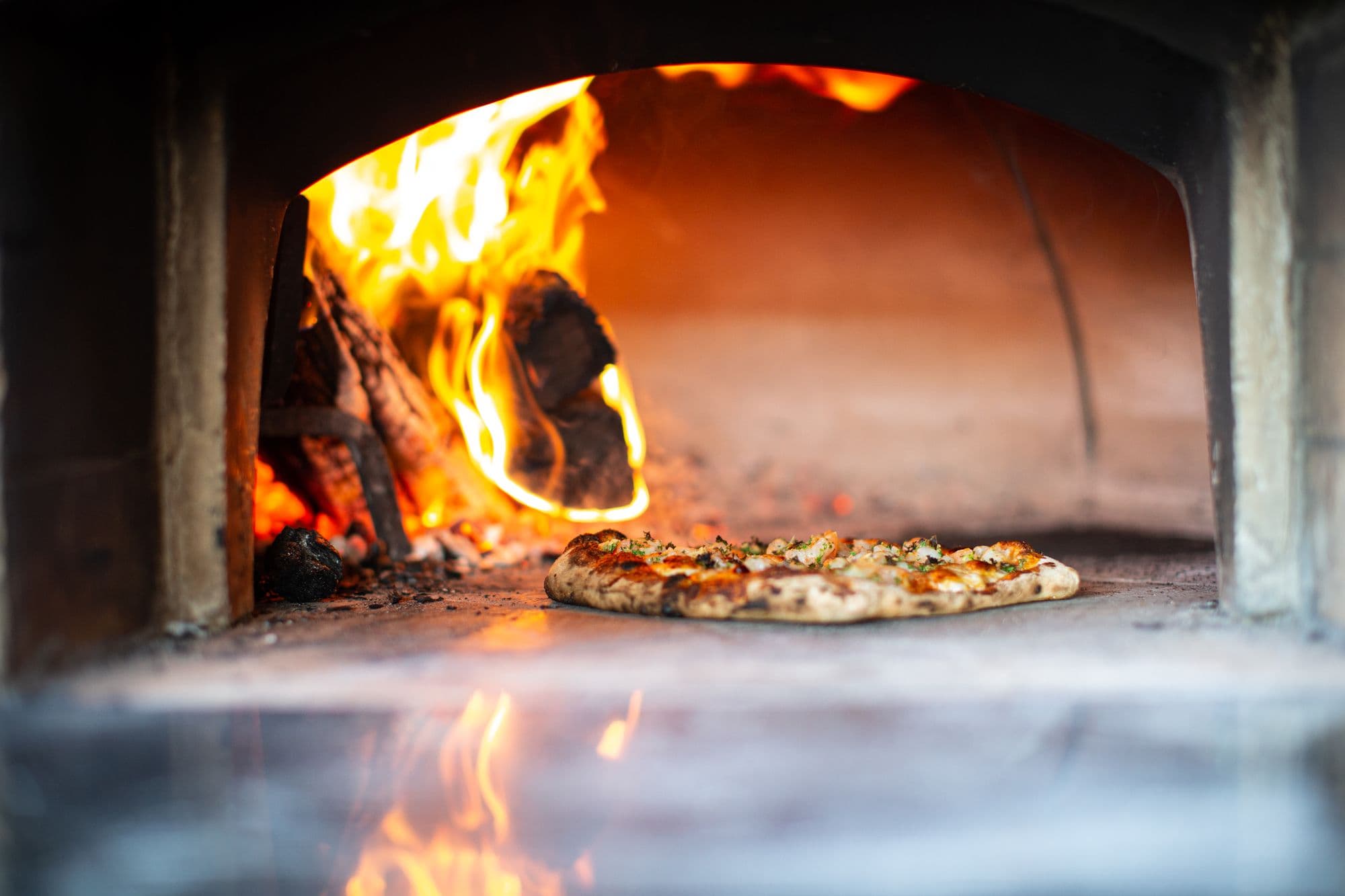
Photo: Derwin Edwards / Pexels (Pexels License)
Outdoor kitchen pizza oven dimensions are governed by one measurement most planning guides never mention: the height of the oven mouth off the ground. Get that wrong and every pizza you launch is a gamble, regardless of how good the oven is.
This page covers the footprint a pizza oven needs on your counter, the counter height that follows from the oven's own height, hearth depth, and the clearances that keep a very hot object safely inside a masonry island.
Top picks for this build
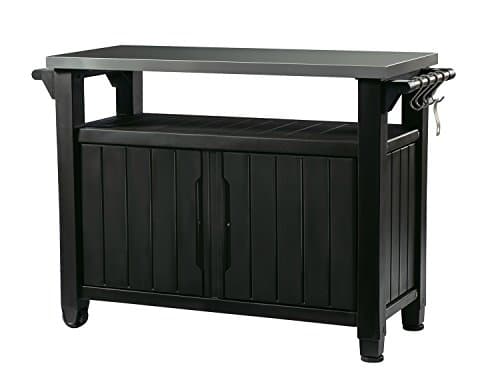
Keter Unity XL Portable Outdoor Table with Stainless Steel Top for Kitchen Prep and Outdoor Storage Cabinet for Grilling Accessories, Dark Grey
$237.99
Check price on Amazon: Keter Unity XL Portable Outdoor Table with Stainless Steel Top for Kitchen Prep and Outdoor Storage Cabinet for Grilling Accessories, Dark Grey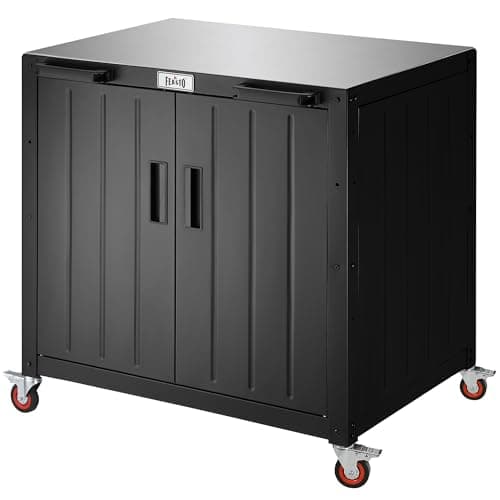
Feasto Modular Outdoor Kitchen Island with Storage and Stainless Steel Top
$229.00
Check price on Amazon: Feasto Modular Outdoor Kitchen Island with Storage and Stainless Steel Top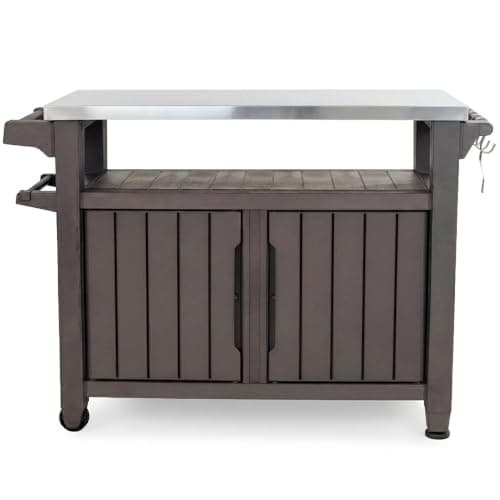
Keter Outdoor Rolling Table Cart for Food Prep, Storage, Dark Brown
See price on Amazon
Check price on Amazon: Keter Outdoor Rolling Table Cart for Food Prep, Storage, Dark Brown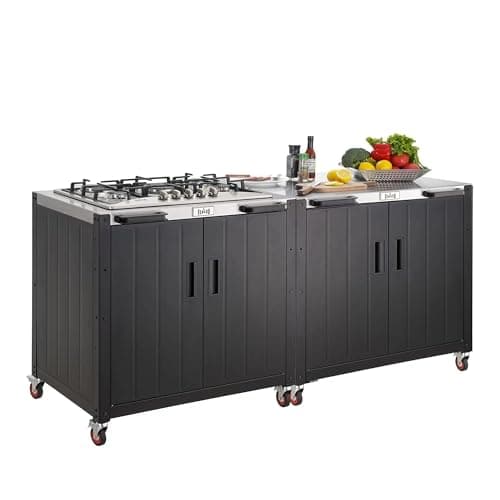
Feasto Outdoor Kitchen,Modular Outdoor Kitchen Island with Storage
$699.99
Check price on Amazon: Feasto Outdoor Kitchen,Modular Outdoor Kitchen Island with Storage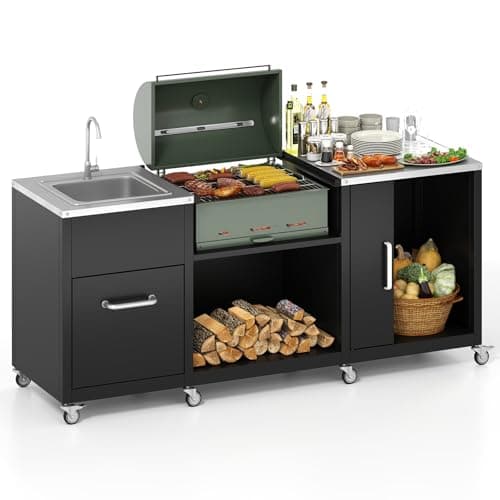
Happygrill 80” Outdoor Grill Table with Sink & Drainage, Wheels
See price on Amazon
Check price on Amazon: Happygrill 80” Outdoor Grill Table with Sink & Drainage, WheelsKeter Unity XL Portable Outdoor Table with Stainless Steel Top for Kitchen Prep and Outdoor Storage Cabinet for Grilling Accessories, Dark Grey
$237.99
Check price on Amazon: Keter Unity XL Portable Outdoor Table with Stainless Steel Top for Kitchen Prep and Outdoor Storage Cabinet for Grilling Accessories, Dark GreyFeasto Modular Outdoor Kitchen Island with Storage and Stainless Steel Top
$229.00
Check price on Amazon: Feasto Modular Outdoor Kitchen Island with Storage and Stainless Steel TopKeter Outdoor Rolling Table Cart for Food Prep, Storage, Dark Brown
See price on Amazon
Check price on Amazon: Keter Outdoor Rolling Table Cart for Food Prep, Storage, Dark BrownFeasto Outdoor Kitchen,Modular Outdoor Kitchen Island with Storage
$699.99
Check price on Amazon: Feasto Outdoor Kitchen,Modular Outdoor Kitchen Island with StorageHappygrill 80” Outdoor Grill Table with Sink & Drainage, Wheels
See price on Amazon
Check price on Amazon: Happygrill 80” Outdoor Grill Table with Sink & Drainage, WheelsPrices and availability are accurate as of October 22, 2026, 11:45 AM UTC and are subject to change.
The Measurement That Matters Most: Mouth Height
Loading a pizza means sliding a peel horizontally into the oven and pulling it out from under the dough in one motion. That works when the oven floor is at roughly the height of your forearm when your elbow is bent — somewhere between 48 and 54 inches (122–137 cm) off the ground for most adults.
Below about 44 inches you crouch to see the deck, and you lose the flat wrist that makes a clean launch possible. Above about 58 inches you cannot see the far side of the oven floor, which matters because that is where the pizza is going.
So the counter height is not a free choice — it is the target mouth height minus the oven's own base-to-mouth height. A countertop oven whose mouth sits 15 inches above its own base wants a counter at 33 to 39 inches. One with a taller body wants a lower counter. Work backwards from the oven, every time.
This is the reason a pizza oven landing is one of the legitimate exceptions to the 36-inch countertop height standard.
Footprint by Oven Type
| Oven type | Typical footprint | Counter space needed | Weight range |
|---|---|---|---|
| Portable gas (12 in pizza) | 16–24 in deep × 15–20 in wide | 36 in of run | 20–40 lb |
| Countertop wood/gas hybrid | 24–32 in deep × 24–30 in wide | 48 in of run | 60–150 lb |
| Built-in insert | 30–40 in deep × 30–40 in wide | Own bay + landing | 200–600 lb |
| Full masonry dome | 48–60 in diameter | Dedicated structure | 1,000–3,000+ lb |
Two things to take from this table. First, depth is the constraint, not width — most pizza ovens are deeper than a standard 25 to 30 inch outdoor counter, so a countertop oven frequently overhangs or requires a deeper bay built specifically for it.
Second, weight decides the structure. Anything above roughly 150 pounds needs its own supported base rather than sitting on a standard countertop, and a masonry dome needs a footing designed for it. A full dome is a foundation question before it is a kitchen question.
Landing Space: The Peel Needs Somewhere to Go
A 12-inch pizza peel is around 30 inches long including the handle, and you need to set it down loaded, turn a pizza on it, and land a cooked one.
Allow at least 24 inches of clear counter immediately beside the oven mouth, and 30 inches is better. This is separate from the oven's own footprint. A pizza oven with no landing space is the outdoor-kitchen equivalent of an oven with no worktop beside it — technically functional, miserable in practice.
The landing should be on the side you naturally work from, and it should be heat-tolerant. Stone or porcelain is ideal. This is not a place for a timber butcher block insert.
Peel size is worth choosing deliberately, because it drives the landing requirement. A launch peel is typically as wide as your largest pizza and has a long handle; a turning peel is small and round with a longer handle still. Two peels means two places to put them down, and the turning peel in particular tends to be set down hot.
Include a metal rest or hook for hot peels in the plan. Laying a 700°F turning peel on a sealed stone counter repeatedly will mark it, and laying it on anything combustible is worse.
Hearth Depth and the Two-Pizza Question
The internal cooking floor depth determines what the oven can actually do.
- Under 13 in / 33 cm: one 10–12 inch pizza at a time. Fine for a family.
- 13–18 in / 33–46 cm: one large pizza with room to turn it properly, or a small roasting dish.
- Over 24 in / 61 cm: two pizzas simultaneously, or genuine bread and roasting capability.
Turning space matters more than people expect. A pizza needs rotating every 20 to 30 seconds in a hot wood oven, and if the hearth is barely wider than the pizza you cannot get the turning peel underneath cleanly. An oven that fits a 12-inch pizza exactly is an oven that cooks 12-inch pizzas unevenly.
Clearances and Combustibles
A wood-fired oven exterior can reach temperatures that will char adjacent timber over repeated use, and the flue is hotter still.
Manufacturers publish minimum clearances to combustible materials for the oven body, and separately for the flue where one exists. Treat both as mandatory. For built-in inserts, the bay is typically required to be non-combustible throughout — masonry, block, or steel stud with cement board — and frequently requires a ventilated air gap around the oven body so heat does not build up inside the enclosure.
Two specific points that get missed:
- Overhead. If the oven sits under a pergola or roof, there is a required vertical clearance and often a flue termination height above the roofline. A wood-fired oven under a low timber pergola without a properly terminated flue is a genuine hazard, not a code technicality.
- The counter material directly beneath. Some ovens require a non-combustible base with a specified air gap. Setting a heavy countertop oven straight onto a sealed timber surface is not safe.
For gas ovens using LP, the installation requirements in NFPA 58 apply as they do to any LP appliance, and your local jurisdiction may amend them.
Where the Oven Goes in the Run
Position is a dimension question too, because a pizza oven is used differently from a grill.
Put it at the end of the run rather than the middle. Pizza cooking is a spectator activity — people gather, and they gather in front of the oven. An oven mid-run puts that crowd between the grill and the fridge. An oven at the end gives it its own pocket of space and keeps the working core of the kitchen clear.
If the oven burns wood, the fuel needs a home within reach: a ventilated bay for a modest amount of seasoned hardwood, sized for an evening's cooking rather than a season's storage. Wood stored in a sealed cabinet outdoors will not stay dry and will attract insects.
See outdoor kitchen with a pizza oven for layout examples, and outdoor kitchen pizza oven for choosing between fuel types.
A Sizing Worksheet
Fill these six blanks and your dimensions are settled.
- Oven base-to-mouth height: ______ in
- Target mouth height (48–54 in): ______ in
- Counter height = line 2 minus line 1: ______ in
- Oven depth: ______ in → counter bay depth needs to be at least this plus 3 in
- Oven width + 24 to 30 in landing: ______ in of run
- Oven weight: ______ lb → over 150 lb needs a dedicated supported base
Those six numbers tell you the counter height, the bay depth, the run length, and whether you need extra structure — which is the entire dimensional brief for a pizza oven in an outdoor kitchen.
A worked example, for a common countertop oven: base-to-mouth height of 15 inches, target mouth height of 51 inches, so counter height is 36 inches — which happens to be standard, and is why many countertop ovens sit comfortably on an ordinary run. Oven depth of 29 inches means the bay needs 32 inches, which is deeper than a standard 27-inch counter, so that section gets built out. Oven width of 26 inches plus a 28-inch landing means 54 inches of run. Weight of 130 pounds is under the threshold, so no special base is required beyond a solid, level, non-combustible surface.
Four of the six answers came out standard and two did not — which is the usual outcome, and precisely why running the worksheet beats assuming the oven will simply fit the kitchen you were already planning.
Frequently Asked Questions
01What height should a pizza oven be in an outdoor kitchen?
02How much counter space does a pizza oven need?
03How deep does the counter need to be for a pizza oven?
04Can a pizza oven sit on a normal outdoor countertop?
05What size pizza oven do I need for a family?
06How much clearance does a pizza oven need from combustibles?
07Where should a pizza oven go in an outdoor kitchen?
08Do I need a bigger island for a pizza oven?
09How much wood storage does a wood-fired oven need?
This guide is part of Outdoor Kitchen Cooking Equipment: Grills, Griddles, Smokers, and Pizza Ovens — the hub covering every grills & cooking guide on Outdoor Kitchen Setup.
Related Guides
Written and edited by Sukie
Sukie is the editor behind Outdoor Kitchen Setup. They compile manufacturer specification sheets, published building codes, and industry sizing standards into the measurement and planning guides on this site, and check every figure against its original source before it goes live. Where a number varies by brand or by local code, the guides say so rather than presenting a single figure as universal.